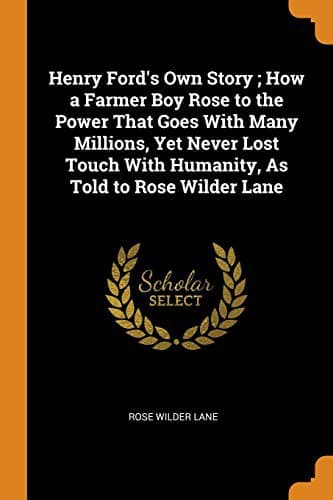
Henry Ford's Own Story: How a Farmer Boy Rose to the Power that goes with Many Millions, Yet Never Lost Touch with HumanityLane, Rose Wilder
Philosophy
Henry Ford's Own Story: How a Farmer Boy Rose to the Power that goes with Many Millions, Yet Never Lost Touch with Humanity
Lane, Rose Wilder
Automobile industry and trade -- United States -- History; Businesspeople -- United States -- Biography; Ford, Henry, 1863-1947
Yet this viewpoint was the natural outcome of his life. A simple man,
seeing things simply, he had arrived at a place of tremendous power in
America. He had come to a time when he need no longer work at his engine
or his factory organization. He had leisure to survey his country and
its problems, to apply to them his machine idea.
And he saw in America a great machine, made up of countless human
parts--a machine which should work evenly, efficiently, harmoniously,
for the production and just distribution of food, shelter, clothes, all
the necessities of a simple and comfortable life.
His part, as he saw it, was to make and distribute automobiles. He meant
to do his part in the best way he knew how, hoping by his success to
hasten the time when every one would follow his example, and all the
terrible friction and waste of our present system would be stopped.
This was his only interest in life. A farmer-boy mechanic, who had left
school at sixteen, who had lived all his life among machines, interested
in practical things, he saw no value in anything which did not promote
the material well-being of the people. Art--music, painting, literature,
architecture--luxuries, super-refinements of living, these things seemed
useless to him.
"Education? Come to Detroit and I'll show you the biggest school in the
world," he says. "Every man there is learning and going ahead all the
time. They're realizing that their interests are the same as their
employer's, that he is the men's trustee, that he is only one of the
workmen with a job of his own, and that his job, like the jobs of the
others, has to be run for the good of the whole plant. He would fire a
man who took away from the other men for his own advantage. That spirit
would harm the works. Similarly, the men would have a right to fire him
if he took away from them for his personal benefit.
"The men in my plant are learning these things. They're leading the way
for the workers of this country. They are going to show other workers,
just as I hope to show other employers, that things should be run for
the most good for the most people. That's the education we need.
"This education outside of industry that we have to-day is just the
perpetuation of tradition and convention. It's a good deal of a joke and
a good deal of waste motion. To my mind, the usefulness of a school ends
when it has taught a man to read and write and figure, and has brought
out his capacity for being interested in his line. After that, let the
man or boy get after what he is interested in, and get after it with all
his might, and keep going ahead--that is school.
"If those young fellows who are learning chemistry in colleges were
enough interested in chemistry they would learn it the way I did, in my
little back shed of nights. I would not give a plugged nickel for all
the higher education and all the art in the world."
Public-domain text, read in full here on John Shaqi.
Reviews
Reviews
No reviews yet
Be the first to share your thoughts on this work.
Elsewhere in the archive
Join the Discussion
Join the discussion
Sign in to leave a comment or review.
Sign InorCreate an account