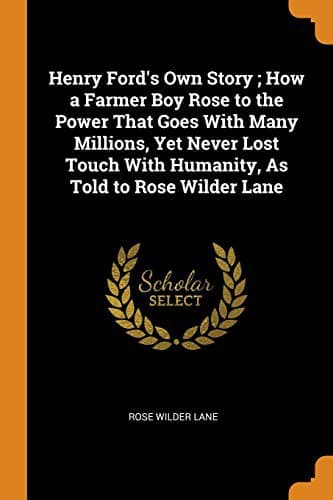
Henry Ford's Own Story: How a Farmer Boy Rose to the Power that goes with Many Millions, Yet Never Lost Touch with HumanityLane, Rose Wilder
Philosophy
Henry Ford's Own Story: How a Farmer Boy Rose to the Power that goes with Many Millions, Yet Never Lost Touch with Humanity
Lane, Rose Wilder
Automobile industry and trade -- United States -- History; Businesspeople -- United States -- Biography; Ford, Henry, 1863-1947
And Henry Ford, reading the papers, listening to the talk of the men in
the streets, saw the object lesson of his great organization
disregarded. He heard again the objection which had met every step of
his life. "It is a good idea, but it is theoretical. It is not
practical. It will not work. Things never have done that way." He saw
this country, already wasting incalculable human energy, destroying
innumerable lives daily, because of a "practical" system of
organization, preparing to drain off still more energy, still greater
wealth, in preparation for a still more terrible waste.
The dearest principle of his life, the principle whose truth he had
proven through a life of hard work, was in danger of being swept away
and forgotten.
CHAPTER XXX
THE BEST PREPAREDNESS
Henry Ford saw that the meaning of his work was about to be lost. He was
in for the greatest fight of his life.
He counted his resources. The mammoth factory was still running to
capacity, the farm tractors, which would mean so much in increased
production of food, in greater comforts for millions of farmers, were
almost ready to be put on the market. His plan for profit-sharing with
the buyers of his cars had recently been announced. Three hundred
thousand men in this country would have, during 1915, an actual proof in
dollars and cents of the practical value of coöperation, of Ford's
principle that "helping the other fellow will help you." Those men would
share with him the profit which would add still more millions to his
credit.
Ford had these things; he had also a tremendous fortune at his command.
He cast about for ways of using that fortune in this fight, and again
the uselessness of money was impressed upon him.
"Money is of no real value whatever," he says. "What can I do with it
now? I cannot pay a man enough to make him change his real opinions. The
only real resource this country has now is the intelligence of our
people. They must think right, they must know the true principles on
which to build a great, strong nation.
"They must hold firm to the big, true things, and realize--some way they
must be MADE to realize--that they are practical, that ideals are the
only practical things in this world.
"It is to everybody's interest to do right. Not in the next world, nor
in a spiritual way only, but in good, hard dollars-and-cents business
value.
"Let's be practical. Suppose we do prepare for war? Suppose we do take
the energies of our young men and spend them in training for war. Our
country needs the whole energy of every man in productive work, work
that will make more food, more clothing, better houses. But suppose we
turn that energy from real uses, train it to destroy, instead of to
create? Suppose we have half a million young men ready to fight? What
weapons shall we give them?
Public-domain text, read in full here on John Shaqi.
Reviews
Reviews
No reviews yet
Be the first to share your thoughts on this work.
Elsewhere in the archive
Join the Discussion
Join the discussion
Sign in to leave a comment or review.
Sign InorCreate an account