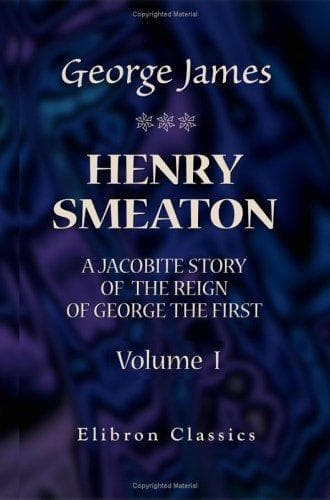
Henry Smeaton: A Jacobite Story of the Reign of George the First.James, G. P. R. (George Payne Rainsford)
General
Henry Smeaton: A Jacobite Story of the Reign of George the First.
James, G. P. R. (George Payne Rainsford)
Jacobite Rebellion, 1715 -- Fiction
"No, you did not," rejoined the Captain. "You did not say anything of
the kind. You were cock-sure, like all the rest of them, that this
lackey was the Earl disguised, and that you would pounce upon him here
like a hawk on a hedge-sparrow."
"But did you not wish to search the house without the slightest
grounds of pretence?" demanded the magistrate. The officer, however,
turned away from him, with a look of half-drunken contempt, and,
addressing himself to the corporal, asked,
"What sort of men were they, corporal?"
"One was short and fat," said the corporal, "with a great many ribbons
about him. The other was a tall man, and seemed youngish, as far as I
could see."
"The Earl and his servant without doubt," said the Justice.
"I suppose so," grumbled Captain Smallpiece, in a disappointed tone.
"What is to be done now? Shall we search?"
"Search! Search for what," demanded the Justice, "when they have got
off to sea? There is no proof they were ever in the house at all, and
very probably have been, during the time, down in one of the huts.
What is to be done! Why, march off your men as fast as possible, and
let us see how we can patch up matters with Sir John Newark. He won't
forget it in a hurry, depend upon it. I require you, sir, to march off
your men."
"Oh, very well," cried the Captain, indignantly. "That shall be done
faster than you like perhaps. There, sound boot and saddle." And he
walked away to the door.
"Could you favour me with a glass of wine, Master Richard?" said the
Justice, in an insinuating tone. "We have ridden far; and this is dry
work."
"Not a drop," replied the boy, boldly. "You came on a fool's errand;
and you may go dry away. I can tell you, Master Best," he added, with
a laugh, "you'll want all the wit in your noddle to settle accounts
with my father; and it would be unkind to take a jot out of the
canister by putting wine in. You have had quite enough to-night
already, I should think; and, at all events, you'll get no more here."
The servants laughed; and, after trying hard for a look of dignity
which would not come, Justice Best walked out of the room, with his
clerk sneaking behind him, like a beaten cur.
"There, there," cried Richard Newark, running out into the hall and to
the foot of the stairs, "shut all the doors and windows. Emmy, Emmy!
Come down. All the fools are gone!"
CHAPTER XIV.
Having already changed the _venue_ once in the same chapter, I have
judged it best to finish one of those fragments into which the caprice
of authorship induces men to divide romances, before I return to Henry
Smeaton and his companion in the passage. We must now, however, leave
the party in the house, and once more place ourselves by the side of
the well where, soon after the last words spoken by Smeaton, the
moving away of the soldiers towards the beach could plainly be
distinguished; and the path without seemed to be left to solitude and
silence.
Public-domain text, read in full here on John Shaqi.
Reviews
Reviews
No reviews yet
Be the first to share your thoughts on this work.
Elsewhere in the archive
Join the Discussion
Join the discussion
Sign in to leave a comment or review.
Sign InorCreate an account