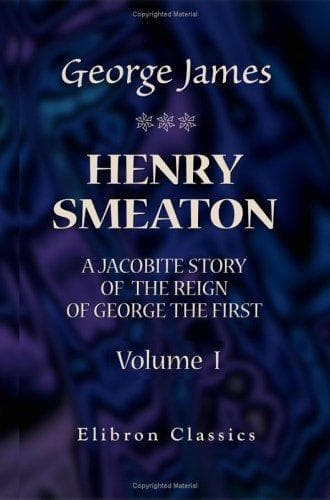
Henry Smeaton: A Jacobite Story of the Reign of George the First.James, G. P. R. (George Payne Rainsford)
General
Henry Smeaton: A Jacobite Story of the Reign of George the First.
James, G. P. R. (George Payne Rainsford)
Jacobite Rebellion, 1715 -- Fiction
She spoke not, however, and Richard ran out of the room in his wild
way to see what all the servants were "making of it," as he termed it.
During his absence, which did not last many minutes, words of mutual
tenderness were of course uttered by the lovers; but other matters
were also to be spoken of besides their young affection, and Smeaton
communicated to Emmeline all that had transpired between himself and
old Mrs. Culpepper, expressing, at the same time, his belief that she
might be fully trusted.
The evening then passed quietly for more than an hour; at the end of
which time the trampling of horses and the voice of Sir John Newark
were heard. He did not come into the small saloon for several minutes
after he had entered the house; and, somewhat to Smeaton's surprise,
neither Emmeline nor Richard Newark went out to greet him. But they
knew him and his ways better than Smeaton did. The interval was
occupied in speaking a few words to Mrs. Culpepper, which seemed to be
rather those of inquiry than anything else; but the replies he
received were apparently satisfactory, and he entered the saloon with
a pleasant and half-laughing air. The whole circumstances of the
evening were discussed, he gave his own version of what had occurred,
both at Exeter and at Aleton, he inquired minutely into the events
which had taken place at the Manor House during his absence, and he
ended by saying--
"Well, Colonel, this is a fortunate escape from that which might have
proved to be a somewhat unpleasant affair, and the mistake these men
have fallen into regarding the flight of the Earl of Eskdale, who has
never fled from them at all, will put you quite at your ease, for some
time, and save you, I trust, from farther annoyance."
He glanced his eye towards Emmeline and Richard, as he spoke, as if to
indicate that it might be better to enter into no more particulars in
their presence, and Smeaton very readily took the hint; for, to say
truth, he had more confidence in Richard's kindness that in his
discretion.
When the two younger members of the family had retired for the night,
Smeaton remained, for a few minutes, to give Sir John an opportunity
of explaining himself further, but Sir John Newark did not think it
necessary to say much more upon the events of that day, merely
observing, in a careless and somewhat light tone--
"I hear your lady wife has quite recovered, and I suppose she may soon
be expected to join you."
"You are labouring under a mistake, my dear sir," replied Smeaton, at
once. "I am quite wifeless."
"Why, I thought," exclaimed Sir John Newark, "that your wife was
mentioned between us only the other day." And he assumed, very
tolerably, an air of incredulous surprise.
Public-domain text, read in full here on John Shaqi.
Reviews
Reviews
No reviews yet
Be the first to share your thoughts on this work.
Elsewhere in the archive
Join the Discussion
Join the discussion
Sign in to leave a comment or review.
Sign InorCreate an account