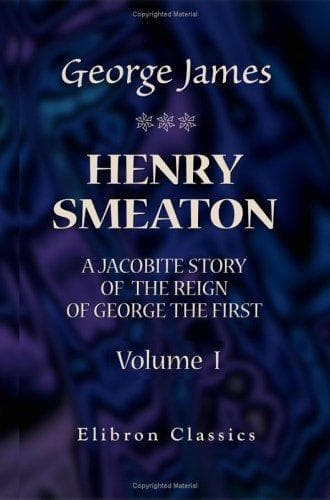
Henry Smeaton: A Jacobite Story of the Reign of George the First.James, G. P. R. (George Payne Rainsford)
General
Henry Smeaton: A Jacobite Story of the Reign of George the First.
James, G. P. R. (George Payne Rainsford)
Jacobite Rebellion, 1715 -- Fiction
"Perfectly safe, if he could come in private," replied Mrs. Culpepper;
"but most dangerous if he were to be seen. Yet stay. He is quite
secure at Grayling's for two or three days. Now, mark what you must
do. Rise early to-morrow, before daylight; go quietly down to him at
the cottage, and tell him what I say--he will understand you. Tell
him, the means of coming in, in private, he shall have by you
to-morrow night. I cannot get the key at present. As soon as you have
delivered the message, come back here, and mind you close and lock the
doors behind you just as you found them. Take care, likewise, to make
no noise."
"If I am to go early in the morning," observed the man, "I had better
stay where I am. I will put the edge of the tankard under my head, and
then my nodding will wake me, from time to time."
"Don't put it too often to your lips," retorted Mrs. Culpepper,
gravely; "for your master's safety and happiness depend on your
carefulness just now."
"Lord bless you, ma'am, I've been accustomed to these things," said
Higham, "and could sit with a tankard of strong waters under my nose
for a month without ever touching a drop, if there was any business to
be done at the end of it."
"You will not lose your reward if you are faithful," said the old
woman; "and so, good night."
As soon as she was gone, Higham murmured to himself--
"She is, on the right side, I _do_ think. She must be a wonderful
cunning old woman."
With this reflection, he folded his arms on the table, laid his head
upon them, and in a few minutes was fast asleep: Every time the
house-clock struck, however, he looked up and counted; and, at the
hour of four, shook off his drowsiness, took a tolerable draught from
the flagon, and then crept quietly out of the servants'-hall. He had
the choice of three doors by which to make his exit. That of the great
hall, however, had, to his knowledge, a very bad habit of creaking on
its hinges. That which led into the court led also to the bloodhound;
and, though he was not at all afraid of the animal's bite, he was
afraid of his bark. There was a little door, however, which led into a
lesser Court, formed expressly, it would seem, for the entertainment
of the men and maid servants of the family; and by this convenient
passage Higham took his way out, with little difficulty and no noise.
Nothing interrupted him on his way to the village; and there, by the
lights he saw in several of the cottages, he perceived that many of
the inmates were up, preparing for some of their lawful or unlawful
occupations. A light was in old Grayling's house also; and, looking
through the window, which had no shutters but plenty of bars, he saw
the old man with a short pipe in his mouth, lighting the fire in the
kitchen.
Tapping at the window, Higham soon brought the fisherman to his door;
and, with one accustomed to somewhat perilous enterprises, very little
explanation was needful.
Public-domain text, read in full here on John Shaqi.
Reviews
Reviews
No reviews yet
Be the first to share your thoughts on this work.
Elsewhere in the archive
Join the Discussion
Join the discussion
Sign in to leave a comment or review.
Sign InorCreate an account