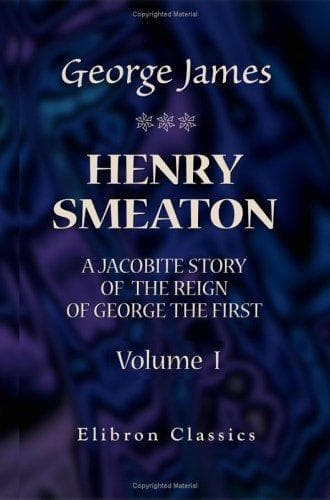
Henry Smeaton: A Jacobite Story of the Reign of George the First.James, G. P. R. (George Payne Rainsford)
General
Henry Smeaton: A Jacobite Story of the Reign of George the First.
James, G. P. R. (George Payne Rainsford)
Jacobite Rebellion, 1715 -- Fiction
Smeaton's love for Emmeline was intense, powerful, enthusiastic; but
it was the love of a man, not of a boy. Ten years before, his thoughts
would have been very different when turned towards her; more
agitating, perhaps, but not so deep and strong. He dwelt, as a lover
might dwell, on the beautiful memory of her look, the symmetry of her
person, the music of her voice, the wild untutored graces of her mind,
the heart-breathing spirit which pervaded everything she said and did;
and the longing to hold her to his bosom again came upon him very
strongly. He thought, too, with pain, of what must be her sensations,
what her distress of mind, to be torn from him and carried away
against her will, at the very moment when their happiness seemed
almost secure; but it was not with that impulsive rashness which, a
few years before, might have led him to fly to her in spite of
obstacles, and without taking means to remove any of the difficulties
which beset their path. He was old enough to struggle with his
impulses, and generally to overcome them when he felt them to be rash.
Thus, in mingled meditation, he rode on, with sweet and pleasant
images presented by memory, and painful reflections chequering the too
bright vision.
He had not gone more than eight miles when he saw a man rapidly
approaching down the slope of the opposite hill. He could hardly
believe that his servant had returned so soon; yet the figure was so
much the same--a diminutive man on a tall horse--that, though some
distance intervened, he recognized him. They met at the bottom of the
valley, and Smeaton asked eagerly,
"Well, what news? Have you brought me a letter?"
"I have brought your own back again, my Lord," replied Higham, holding
it out to his master, as he rode up; "and no other answer could I
get."
"No answer!" echoed Smeaton, taking the letter, and seeing that it had
been opened. "What did he say, or cause to be said to you?"
"Oh, he said very little," replied the man, "and caused nothing to be
said at all; for he seemed quite capable of speaking for himself, and
that pretty sharply. He broke open the letter, read it through from
beginning to end, and then thrust it into my hand, saying, 'You had
better ride back again.' I asked if he would not send an answer by me,
or if he would send one afterwards. But he said no answer was needed,
and called out: 'Take it back to him who sent you. That is the only
answer.'"
Smeaton's cheek burned, and his heart beat angrily.
"This is insult," he muttered. "This is insult as well as injury. Some
day I may call him to account for it."
"I must say for him, my Lord," added the man, "that it was not a lucky
moment to fall upon; for he was at the head of the men drawn up on the
little green, and just ready to march."
Public-domain text, read in full here on John Shaqi.
Reviews
Reviews
No reviews yet
Be the first to share your thoughts on this work.
Elsewhere in the archive
Join the Discussion
Join the discussion
Sign in to leave a comment or review.
Sign InorCreate an account