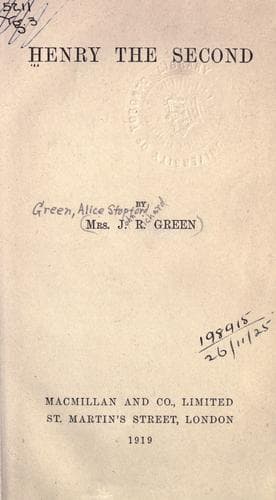
Great Britain -- History -- Henry II, 1154-1189; Henry II, King of England, 1133-1189
The rivalry of Raymond and Strongbow was at its height when, in 1176,
Earl Richard died; and to this day his burial-place in the Norman
Cathedral in Dublin, and that of his wife Aeifi, are marked by the only
sculptured tombs that exist of these first Norman conquerors of Ireland.
Others besides the king heard with joy the news that the great warrior
was dead. Richard's sister, who had been married to Raymond, had cast in
her lot with her lord. She sent a cautious despatch to her husband, who
was unable himself to read, and had to depend on the good offices of a
clerk. "Know, my dearest lord," wrote the prudent wife, "that that great
tooth which pained me so long has now fallen out, wherefore see that you
delay not your return." The watchful Henry, however, at once recalled
Raymond to England, and sent a new governor, Fitz-Aldhelm, to hold the
restless barons in check, till his son John, to whom he now proposed to
give the realm of Ireland, should be of age to undertake its government.
When Fitz-Aldhelm saw the magnificent troop of Raymond's cousins and
nephews, who had thrown aside all armour save shields, and, mounted on
splendid horses, dashed across the plain to display their feats of
agility and horsemanship, he muttered to his followers, "This pride I
will shortly abate, and these shields I will scatter." He was true to
his word. The fortunes of the knights of both parties indeed rapidly
declined; "those who had been first had to learn to be last;" their
lands were taken from them on every excuse, and they were followed by
the enmity and persecution of the king. For the next ten years the
history of the English in Ireland is a miserable record of ineffective
and separate wars undertaken by leaders each acting on his own account,
and of watchful jealousy on the part of Henry. A new governor was sent
in 1177 to replace Fitz-Aldhelm. Hugh de Lacy was no Norman. His black
hair, his deep-set black eyes, his snub nose, the scar across his face,
his thin ill-shapen figure, marked him out from the big fair Fitz-Geralds,
as much as did his "Gallican sobriety" and his training in affairs, for
in war he had no great renown. Perhaps it was some quick French quality
in him that won the love of the Irish. But Henry was suspicious and
uneasy. He was recalled in 1181 on the news that without the king's leave
he had married the daughter of the King of Connaught, and rumour added
that he had even made ready a diadem for himself. But his services were
so valuable that that same winter he was sent back, only to be again
recalled in 1184 and again sent back. At last in 1186, "as though fortune
had been zealous for the king of England," he was treacherously slain by
an Irishman, to Henry's "exceeding joy."
Public-domain text, read in full here on John Shaqi.
Reviews
Reviews
No reviews yet
Be the first to share your thoughts on this work.
Elsewhere in the archive
Join the Discussion
Join the discussion
Sign in to leave a comment or review.
Sign InorCreate an account