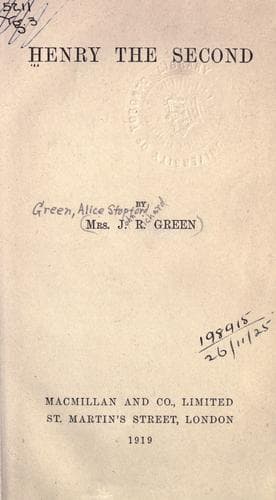
Great Britain -- History -- Henry II, 1154-1189; Henry II, King of England, 1133-1189
Henry, however, was absolute master of the whole central administration
of the realm. Moreover, by his decree of the year before he had set over
every shire a sheriff who was wholly under his own control, trained in
his court, pledged to his obedience, and who had firm hold of the
courts, the local forces, and the finances. The king now hastened to
appoint bishops whom he could trust to the vacant sees. Geoffrey, an
illegitimate son who had been born to him very early, probably about the
time when he visited England to receive knighthood, was sent to Lincoln;
and friends of the king were consecrated to Winchester, Ely, Bath,
Hereford, and Chichester. Prior Richard of Dover, a man "laudably
inoffensive who prudently kept within his own sphere," was made Archbishop
of Canterbury. Richard de Lucy remained in charge of the whole kingdom as
justiciar. The towns and trading classes were steadfast in loyalty, and
the baronage was again driven, as it had been before, to depend on foreign
mercenaries.
War first broke out in France in the early summer of 1173. Normandy and
Anjou were badly defended, and their nobles were already half in revolt,
while the forces of France, Flanders, Boulogne, Chartres, Champagne,
Poitou, and Britanny were allied against Henry. The counts of Flanders
and Boulogne invaded Normandy from the north-east, and the traitor Count
of Aumale, the guardian of the Norman border, gave into their hands his
castles and lands. Louis and Henry's sons besieged Verneuil in the
south-west. To westward the Earl of Chester and Ralph of Fougères
organized a rising in Britanny. In "extreme perplexity," utterly unable
to meet his enemies in the field, Henry could only fortify his frontier,
and hastily recall the garrison which he had left in Ireland, while he
poured out his treasure in gathering an army of hired soldiers. Meanwhile
he himself waited at Rouen, "that he might be seen by all the people,
bearing with an even mind whatever happened, hunting oftener than usual,
showing himself with a cheerful face to all who came, answering patiently
those who wished to gain anything from him; while those whom he had
nourished from days of childhood, those whom he had knighted, those who
had been his servants and his most familiar counsellors, night by night
stole away from him, expecting his speedy destruction and thinking the
dominion of his son at once about to be established." Never did the kings
show such resource and courage as in the campaign that followed. The Count
of Boulogne was killed in battle, and the invading army in the north-east
hesitated at the unlucky omen and fell back. Instantly Henry seized his
opportunity. He rode at full speed to Verneuil with his army, a hastily
collected mob of chance soldiers so dissatisfied and divided in allegiance
that he dared not risk a battle. An audacious boast saved the crafty king.
"With a fierce countenance and terrible voice" he cried to the French
Public-domain text, read in full here on John Shaqi.
Reviews
Reviews
No reviews yet
Be the first to share your thoughts on this work.
Elsewhere in the archive
Join the Discussion
Join the discussion
Sign in to leave a comment or review.
Sign InorCreate an account