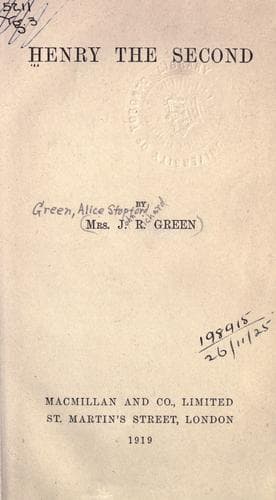
Great Britain -- History -- Henry II, 1154-1189; Henry II, King of England, 1133-1189
With the spring of 1174, however, the strife raged again on all sides.
Ireland rose in rebellion. William of Scotland marched into England
supported by a Flemish force. Roger Mowbray, and probably the Bishop of
Durham, were in league with him. Earl Ferrers fortified his castles in
Derby and Stafford; Leicester Castle was still held by the Earl of
Leicester's knights; Huntingdon by the Scot king's brother; and the Earl
of Norfolk was joined in June by a picked body of Flemings. The king's
castles at Norwich, Northampton, and Nottingham, were taken by the rebels,
and a formidable line of enemies stretched right across mid-England.
At the same time France and Flanders threatened invasion with a strong
fleet, and "so great an army as had not been seen for many years." Count
Philip, who had set his heart on the promised Kent, and on winning
entrance into the lands of the Cistercian wool-growers of Lincolnshire,
swore before Louis and his nobles that within fifteen days he would attack
England; the younger Henry joined him at Gravelines in June, and they only
waited for a fair wind to cross the Channel.
The justiciars were in an extremity of despair. "Seeing the evil that
was done in the land," they anxiously sent messenger after messenger to
the king. But Henry had little time to heed English complaints. Richard
had declared war in Aquitaine; Maine and Anjou were half in revolt;
Louis was on the point of invading Normandy. As a last resource his
hard-pressed ministers sent Richard of Ilchester, the bishop-elect of
Winchester, whom they knew to be favoured by the king beyond all others,
to tell him again of "the hatred of the barons, the infidelity of the
citizens, the clamour of the crowd always growing worse, the greed of
the 'new men,' the difficulty of holding down the insurrection." "The
English have sent their messengers before, and here comes even this
man!" laughed the Normans; "what will be left in England to send after
the king save the Tower of London!" Richard reached Henry on the 24th of
June, and on the same day Henry abandoned Normandy to Louis' attack, and
made ready for return. "He saw that while he was absent, and as it were
not in existence, no one in England would offer any opposition to him
who was expected to be his successor;" and he "preferred that his lands
beyond the sea should be in peril rather than his own realm of England."
Sending forward a body of Brabantines, he followed with his train of
prisoners--Queen Eleanor, Queen Margaret and her sister Adela, the
Earls of Chester and of Leicester, and various governors of castles whom
he carried with him in chains. In an agony of anxiety the king watched
for a fair wind till the 7th of July. At last the sails were spread; but
of a sudden the waves began to rise, and the storm to grow ominously.
Those who watched the face of the king saw him to be in doubt; then he
lifted his eyes to heaven and prayed before them all, "If I have set
Public-domain text, read in full here on John Shaqi.
Reviews
Reviews
No reviews yet
Be the first to share your thoughts on this work.
Elsewhere in the archive
Join the Discussion
Join the discussion
Sign in to leave a comment or review.
Sign InorCreate an account