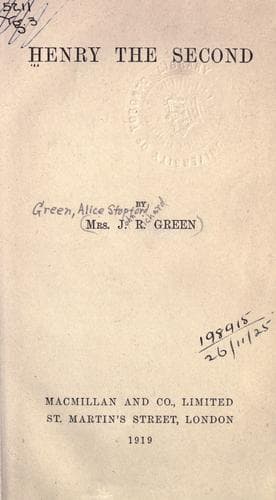
Great Britain -- History -- Henry II, 1154-1189; Henry II, King of England, 1133-1189
The revolt of 1173-74 was the final ruin of the old party of the Norman
baronage. The Earl of Chester got back his lands, but lost his castles,
and was sent out of the way to the Irish war; he died before the king in
1181. Leicester humbly admitted "that he and all his holdings were at
the mercy of the king," and Henry "restored to him Leicester, and the
forest which by common oath of the country had been sworn to belong to
the king's own domain, for he knew that this had been done for envy, and
also because it was known that the king hated the earl;" but Henry had a
long memory, and the walls of Leicester were in course of time thrown
down and its fortifications levelled. The Bishop of Durham had to pay
200 marks of silver for the king's pardon, and give up Durham Castle. At
the death of Hugh Bigod in 1177 Henry seized the earl's treasure. The
Earls of Clare and Gloucester died within two years, and the king's son
John was made Gloucester's heir. The rebel Count of Aumale died in 1179,
and his heiress married the faithful Earl of Essex, who took the title
of Aumale with all the lands on both sides of the water. In 1186 Roger
Mowbray went on crusade. The king took into his own hands all castles,
even those of "his most familiar friend," the justiciar De Lucy. The
work of dismantling dangerous fortresses which he had begun twenty years
before was at last completed, and no armed revolt of the feudal baronage
was ever again possible in England.
But the rebellion had wakened in the king's mind a deep alarm, which
showed itself in a new severity of temper. Famine and plague had fallen
on the country; the treasury was well nigh empty; law and order were
endangered. Henry hastened to return as soon as his foreign campaign was
over, and in May 1175 "the two kings of England, whom a year before the
breadth of the kingdom could not contain, now crossed in one ship, sat
at one table, and slept in one bed." In token of reconciliation with the
Church they attended a synod at Westminster, and went together on solemn
pilgrimage to the martyr's tomb. Then they made a complete visitation of
the whole kingdom. Starting from Reading on the 1st of June, they went
by Oxford to Gloucester, then along the Welsh border to Shrewsbury,
through the midland counties by Lichfield and Nottingham to York, and
then back to London, having spent on their journey two months and a few
days; and in autumn they made a progress through the south-western
provinces. At every halt some weighty business was taken in hand. The
Church was made to feel anew the royal power. Twelve of the great abbeys
were now without heads, and the king, justly fearing lest the monks
should elect abbots from their own body, "and thus the royal authority
should be shaken, and they should follow another guidance than his own,"
sent orders that on a certain day chosen men should be sent to elect
acceptable prelates at his court and in his presence. The safety of the
Welsh marches was assured.
Public-domain text, read in full here on John Shaqi.
Reviews
Reviews
No reviews yet
Be the first to share your thoughts on this work.
Elsewhere in the archive
Join the Discussion
Join the discussion
Sign in to leave a comment or review.
Sign InorCreate an account