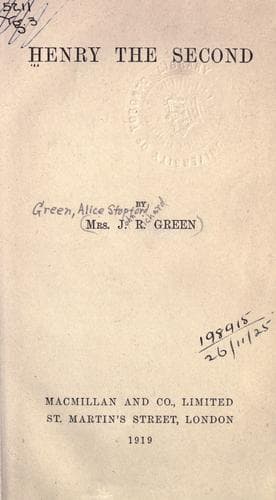
Great Britain -- History -- Henry II, 1154-1189; Henry II, King of England, 1133-1189
It is true that on Henry himself the strife with the Church left deep
traces. He became imperious, violent, suspicious. The darker sides of
his character showed themselves, its defiance, its superstition, its
cynical craft, its passionate pride, its ungoverned wrath. His passions
broke out with a reckless disregard of earlier restraints. Eleanor was a
prisoner and a traitor; she was nearly fifty when he himself was but
forty-one. From this time she practically disappeared out of Henry's
life. The king had bitter enemies at court, and they busied themselves
in spreading abroad dark tales; more friendly critics could only plead
that he was "not as bad as his grandfather." After the rebellion of 1174
he openly avowed his connection with Rosamond Clifford, which seems to
have begun some time before. Eleanor was then in prison, and tales of
the maze, the silken clue, the dagger, and the bowl, were the growth of
later centuries. But "fair Rosamond" did not long hold her place at
court. She died early and was carried to Godstowe nunnery, to which rich
gifts were sent by her friends and by the king himself. A few years
later Hugh of Lincoln found her shrine before the high altar decked with
gold and silken hangings, and the saintly bishop had the last finery of
Rosamond swept from the holy place, till nothing remained but a stone
with the two words graven on it, "Tumba Rosamundae."
But behind Henry's darkest and sternest moods lay a nature quick in
passionate emotion, singularly sensitive to affection, tender, full of
generous impulse, clinging to those he loved with yearning fidelity and
long patience. The story of St. Hugh shows the unlimited influence won
over him by a character of singular holiness. Henry had brought Hugh
from Burgundy, and set him over a newly-founded Cistercian priory at
Witham. The little settlement was in sore straits, and the impatient
monks railed passionately at the king, who had abandoned them in their
necessities. It was just after the rebellion, and Henry, hard pressed by
anxiety, was in his harshest and most bitter temper. "Have patience,"
said Hugh, "for the king is wise beyond measure and wholly inscrutable;
it may be that he delays to grant our request that he may try us." But
brother Girard was not to be soothed, and in a fresh appeal to the king
his vehemence broke out in a torrent of reproaches and abuse. Henry
listened unmoved till the monk ceased from sheer lack of words. There
was dead silence for a time, while Prior Hugh bent down his head in
distress, and the king watched him under his eyelids. At last, taking no
more notice of the monk than if he never existed, Henry turned to Hugh,
"What are you thinking of, good man?" he said. "Are you preparing to go
away and leave our kingdom?" Hugh answered humbly and gently, "I do not
despair of you so far, my lord; rather I have great sorrow for the
troubles and labours which hinder the care for your soul. You are busy
Public-domain text, read in full here on John Shaqi.
Reviews
Reviews
No reviews yet
Be the first to share your thoughts on this work.
Elsewhere in the archive
Join the Discussion
Join the discussion
Sign in to leave a comment or review.
Sign InorCreate an account