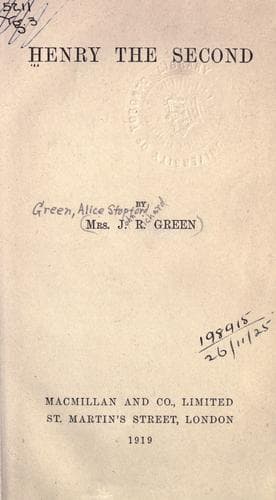
Great Britain -- History -- Henry II, 1154-1189; Henry II, King of England, 1133-1189
courtiers over the Church. There were many other theologians besides
Hugh of Lincoln among the king's friends--Baldwin, afterwards archbishop;
Foliot, one of the chief scholars of his time; Richard of Ilchester, as
learned in theology as capable in administration; John of Oxford, lawyer
and theologian; Peter of Blois, ready for all kinds of services that might
be asked, and as skilled in theology as in rhetoric. Henry was never known
to choose an unworthy friend; laymen could only grumble that he was
accustomed to take advice of bishops and abbots rather than that of
knights even about military matters. But theology was not the main
preoccupation of the court. Henry, inquisitive in all things, learned
in most, formed the centre of a group of distinguished men which, for
varied intellectual activity, had no rival save at the university of
Paris. There was not a court in Christendom in the affairs of which the
king was not concerned, and a crowd of travellers was for ever coming and
going. English chroniclers grew inquisitive about revolutions in Norway,
the state of parties in Germany, the geography of Spain. They copied
despatches and treaties. They asked endless questions of every traveller
as to what was passing abroad, and noted down records which have since
become authorities for the histories of foreign states. Political and
historical questions were eagerly debated. Gerald of Wales and Glanville,
as they rode together, would discuss why the Normans had so fallen away in
valour that now even when helped by the English they were less able to
resist the French than formerly when they stood alone. The philosophic
Glanville might suggest that the French at that time had been weakened by
previous wars, but Gerald, true to the feudal instincts of a baron of the
Norman-Welsh border, spoke of the happy days before dukes had been made
into kings, who oppressed the Norman nobles by their overbearing violence,
and the English by their insular tyranny; "For there is nothing which so
stirs the heart of man as the joy of liberty, and there is nothing which
so weakens it as the oppression of slavery," said Gerald, who had himself
felt the king's hand heavy on him.
Public-domain text, read in full here on John Shaqi.
Reviews
Reviews
No reviews yet
Be the first to share your thoughts on this work.
Elsewhere in the archive
Join the Discussion
Join the discussion
Sign in to leave a comment or review.
Sign InorCreate an account