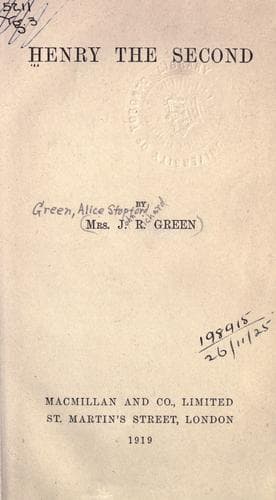
Great Britain -- History -- Henry II, 1154-1189; Henry II, King of England, 1133-1189
His death, however, only opened new anxieties. Richard now claimed to
take his brother's place as heir to the imperial dignity, while at the
same time he exercised undivided lordship over an important state a
position which the king had again and again refused to Henry. Geoffrey,
whose over-lord the young king had been, sought to rule Britanny as a
dependent of Philip, and his plots in Paris with the French king were
only ended by his death in 1185. Philip, on his part, demanded, at the
death of the young king, the restoration of Margaret's dowry, the Vexin
and Gisors; when Geoffrey died he claimed to be formally recognized as
suzerain of Britanny, and guardian of his infant; he demanded that
Richard should do homage directly to him as sovereign lord of Aquitaine,
and determined to assert his rights over the lands so long debated of
Berri and Auvergne. For the last years of Henry's reign disputes raged
round these points, and more than once war was only averted by the
excitement which swept over Europe at the disastrous news from the Holy
Land.
After the death of the young king a precarious peace was established in
Aquitaine, and Henry returned to England. In March 1185 he received at
Reading the patriarch of Jerusalem and the master of the Hospital,
bearing the standard of the kings of the Holy Land, with the keys of the
Holy Sepulchre, of the tower of David, and of the city of Jerusalem.
"Behold the keys of the kingdom," said the patriarch Heracles with a
burst of tears, "which the king and princes of the land have ordered me
to give to thee, because it is in thee alone, after God, that they have
hope and confidence of salvation." The king reverently received them
before the weeping assembly, but handed them back to the safekeeping of
the patriarch till he could consult with his barons. He had long been
pledged to join the holy war; he had renewed his vow in 1177 and 1181.
But it was a heavy burden to be now charged with the crown of Jerusalem.
Since the days of his grandfather, Fulk of Anjou, the last strong king
of Jerusalem, there had been swift decay. Three of his successors were
minors; Antone was a leper; the fifth was repudiated by every one of his
vassals. The last forty years had been marked by continual disaster. The
armies of the Moslem were closing in fast on every side. A passion of
sympathy was everywhere roused by the sorrows of the Holy City. All
England, it was said, desired the crusade, and Henry's prudent counting
of the cost struck coldly on the excited temper of the time. Gerald of
Wales officiously took on himself, in the middle of a hunting party, to
congratulate the king on the honour done to him and his kingdom, since
the patriarch had passed by the lands of emperors and kings to seek out
the English sovereign. Talk of this kind before all the court at such a
critical moment much displeased the prudent king, and he answered in his
biting way, "If the patriarch, or any other men come to me, they seek
Public-domain text, read in full here on John Shaqi.
Reviews
Reviews
No reviews yet
Be the first to share your thoughts on this work.
Elsewhere in the archive
Join the Discussion
Join the discussion
Sign in to leave a comment or review.
Sign InorCreate an account