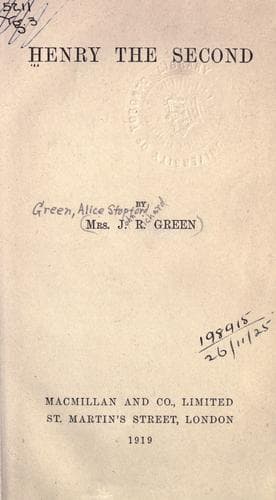
Great Britain -- History -- Henry II, 1154-1189; Henry II, King of England, 1133-1189
heart, whom I have loved beyond all my sons, and for whose gain I have
brought upon me all this misery, has forsaken me?" Then he laid himself
down again and turned his face to the wall. "Now you have said enough," he
said. "Let all the rest go as it will, I care no more for myself nor for
the world." From this time he grew delirious. But still in the intervals
of his ravings the great passionate nature, the defiance, the unconquered
will broke out with inextinguishable force. He cursed the day on which he
was born, and called down Heaven's vengeance on his sons. The great king's
pride was bowed in the extremity of his ruin and defeat. "Shame," he
muttered constantly, "shame on a conquered king." Geoffrey watched by him
faithfully, and the dying king's last thoughts turned to him with grateful
love. On the 6th of July, the seventh day of his illness, he was seized
with violent hemorrhage, and the end came almost instantaneously. The next
day his body was borne to Fontevraud, where his sculptured tomb still
stands. To the astonished onlookers at the great tragedy, the grave in a
convent church, separated from the tombs of his Angevin forefathers and of
his Norman ancestors, far from his English kingdom, seemed part of the
strange disasters foretold by Merlin and inspired messengers. But no
ruler of his age had raised for himself so great a monument as Henry.
Amid the ruin that overwhelmed his imperial schemes, his realm of
England stood as the true and lasting memorial of his genius. Englishmen
then, as Englishmen now, taught by the "remembrance of his good times,"
recognized him as one of the foremost on the roll of those who have been
the makers of England's greatness.
Public-domain text, read in full here on John Shaqi.
Reviews
Reviews
No reviews yet
Be the first to share your thoughts on this work.
Elsewhere in the archive
Join the Discussion
Join the discussion
Sign in to leave a comment or review.
Sign InorCreate an account