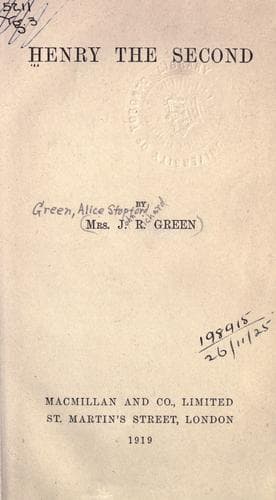
Great Britain -- History -- Henry II, 1154-1189; Henry II, King of England, 1133-1189
Meanwhile the king and his inner council, to which the bishops were
now summoned, were busy discussing what must be done. Henry's position
was one of extreme difficulty, suddenly called on as he was to deal
with a legacy of difficulties which had been left from the unsettled
controversies of a hundred years. By coming to the court in his pontifical
dress Thomas had raised a claim that a bishop could only be tried dressed
in full pontificals by his fellow-bishops also in full dress. He had
thrown aside the king's jurisdiction by his appeal to Rome; and by his
orders to the bishops to judge no further with the barons in this suit
he had further violated the "customs" of the realm to which he had himself
commanded the bishops to swear obedience at Clarendon. None of the
questions raised by Thomas indeed were raised for the first time. William
of St. Carileph, when charged by Rufus with treason, had asserted the
privilege of a bishop to be tried in pontifical dress, and to be judged
only by the canon law in an ecclesiastical court, and had claimed the
right of appeal to Rome. But such doctrines were in those days new and
somewhat doubtful, not supported in any degree by the Church and quite
outside the sympathy of nobles and people, and Lanfranc had easily
eluded the Bishop of Durham's claims. Anselm himself had accepted
a number of points disputed now by Thomas. He frankly admitted the king's
authority in appointing him to the see of Canterbury; he submitted to the
jurisdiction of the King's Court; he made no claims to clerical privileges
or special forms of trial. He had indeed given the first example of a
saving clause in his oath to keep the customs of the kingdom; but the
clause he used, "according to God," was radically different from that of
Thomas, and asserted no different law of obedience for clerk and
for layman. In the reign of Stephen the question of ecclesiastical
jurisdiction ad been raised at the trial of Bishop Roger of Salisbury; but
in this case too the difficulty had been evaded by a temporary expedient,
and the real principle at issue was left untouched. Thomas had in fact
taken up a position which had never been claimed by any great churchman
of the past. The rising tide of ecclesiastical feeling had swept him on
far beyond any of his predecessors. Not even in Anselm's time had the
people in an ecstasy of religious fervour pressed to the gate of the
judgment hall and knelt for the blessing of the saint with a passion of
sympathy and devotion. No problem of such proportions in the relations of
Church and State had ever before presented itself to a king of England.
Public-domain text, read in full here on John Shaqi.
Reviews
Reviews
No reviews yet
Be the first to share your thoughts on this work.
Elsewhere in the archive
Join the Discussion
Join the discussion
Sign in to leave a comment or review.
Sign InorCreate an account