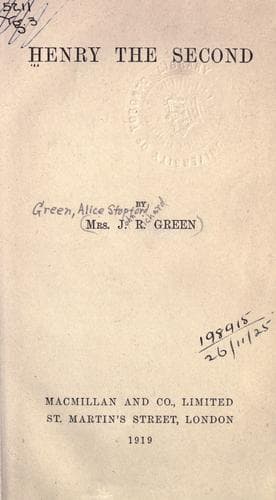
Great Britain -- History -- Henry II, 1154-1189; Henry II, King of England, 1133-1189
himself, looking closely out on the "strangers' ships" that made their
way along the Ouse laden with provisions and with merchandise.
But this growing wealth was still mainly confined to the towns. The
great bulk of the country was purely agricultural, and had no concern in
any questions of trade. There is a record of over five hundred pleas of
the Gloucestershire fifty years later, and among all these there is
outside the _town_ of Gloucester but one case which deals with the lawful
width for weaving cloth, and one or two as to the sale of bread, ale, or
wine. The agricultural peasants seem, from the glimpses which we catch
here and there, to have for the most part lived on the very verge
of starvation. Every few years with dreary regularity we note the
chronicler's brief record of cattle-plague, famine, pestilence. Half
a century later we read in legal records the tale of a hard winter and
its consequences--the dead bodies of the famine-stricken serfs lying in
the fields on every side, and the judges of the King's Court claiming from
the starving survivors the "murder-fine" ordained by law to be paid for
every dead body found when the murderer was not produced. The system of
cultivation was ignorant and primitive. Rendered timid by the repeated
failure of crops, the poor people would set aside a part of their land to
sow together oats, barley, and wheat, in the hope that whatever were the
season something would come up which might serve for the rough black bread
which was their main food. The low wet grounds were still undrained, and
the number of cases of eye-disease which we find in the legends of
miraculous cures point to the prevalence of ophthalmia brought on by damp
and low living, as the army of lepers points to the filth and misery of
the poor .The "common fields" and pastures of the villages must have lain
on the higher grounds which were not mere swamps during half the year. But
to these a dry season brought ruin. In time of drought the cattle had to
be driven five or six miles to find water in the well or pool which served
for the whole district. If by any chance disease broke out, the wearied
beasts that met at the watering or drank of the tainted pool carried it
far and wide, and plague soon raged from end to end of the country. Even
in the days of Henry VIII. shrewd observers noted that the new grazing
farms, where the cattle were better fed and kept separate, alone escaped
these ravages, and that it was these farms whence came the only meat to be
found in the country through the long winter months or in time of murrain.
This purpose was doubtless served earlier by the great monastic estates,
but means of transport scarcely existed; each district had to live on its
own resources, and vast tracts of country were with every unfavourable
season stricken by hunger and by the plague and famine fever that
followed it.
Public-domain text, read in full here on John Shaqi.
Reviews
Reviews
No reviews yet
Be the first to share your thoughts on this work.
Elsewhere in the archive
Join the Discussion
Join the discussion
Sign in to leave a comment or review.
Sign InorCreate an account