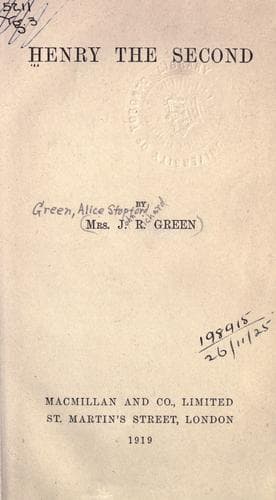
Great Britain -- History -- Henry II, 1154-1189; Henry II, King of England, 1133-1189
Henry perhaps already saw the deep current of discontent which only a
year later was to break out in the most terrible rebellion of his reign.
In any case the severity of the measures which he took shows how serious
he thought the crisis. After his landing in March 1170 one month was
given to inquiry as to the state of the country. In the beginning of
April he held a council to consider the reform of justice. A commission
was appointed to examine, during the next two months, every freeholder
throughout the kingdom as to the conduct of judges and sheriffs and
every other officer charged with the duty of collecting or accounting
for the public money. Its members were chosen from among the most
zealous opponents of the Court officials-the great barons, the priors,
the important abbots of the shires--and they were all men who had no
connection with the Exchequer or the Curia Regis. Their work was done,
and their report presented within the time allowed; but the king,
practical, businesslike, impatient of abuses, like every vigorous
autocratic ruler, had no mind to wait two months to redress the grievances
of his people. The barons who had been appointed as sheriffs at the
opening of his reign had governed after the old corrupt traditions, or
perhaps themselves suffering under the ruthless pressure of the barons of
the Exchequer, had been driven to a like severity of extortion. By an
edict of the king every sheriff throughout the country was struck from
his post; of the twenty-seven only seven were restored to their places,
and new sheriffs were appointed, all of whom save four were officers of
the King's Court. The great local noble who had lorded it as he chose over
the suitors of the Court for fifteen years, and fined and taxed and
forfeited as seemed good to him, suddenly, without a moment's warning,
saw his place filled by a stranger, a mere clerk trained in the Court
among the royal servants, a simple nominee of the king; he could no
longer doubt that the royal supremacy was now without rival, without
limit, irresistible, complete. Such an act of absolute authority had
indeed, as Dr. Stubbs says, "no example in the history of Europe since
the time of the Roman Empire, except possibly in the power wielded by
Charles the Great."
Public-domain text, read in full here on John Shaqi.
Reviews
Reviews
No reviews yet
Be the first to share your thoughts on this work.
Elsewhere in the archive
Join the Discussion
Join the discussion
Sign in to leave a comment or review.
Sign InorCreate an account