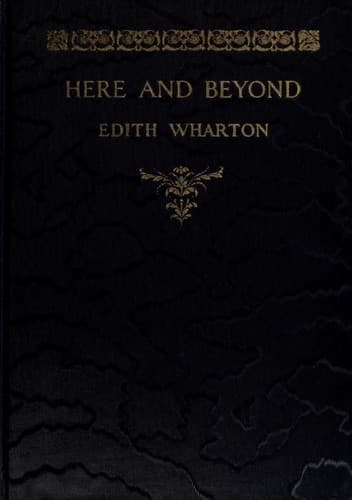
American fiction -- 20th century; Short stories, American
“No, sir.” The young man stumbled to his feet.
“Nor I. The heat is really.... Shall we seek relief on the terrace?”
Bent followed him, and having extinguished the lamp Mr. Blandhorn led
the way out. He dragged a strip of matting to the edge of the parapet,
and the two men sat down on it side by side.
There was no moon, but a sky so full of stars that the city was outlined
beneath it in great blue-gray masses. The air was motionless, but every
now and then a wandering tremor stirred it and died out. Close under the
parapet lay the bales and saddle-packs of the caravansary, between
vaguer heaps, presumably of sleeping camels. In one corner, the
star-glitter picked out the shape of a trough brimming with water, and
stabbed it with long silver beams. Beyond the court rose the
crenellations of the city walls, and above them one palm stood up like a
tree of bronze.
“Africa—” sighed Mr. Blandhorn.
Willard Bent started at the secret echo of his own thoughts.
“Yes. Never anything else, sir—”
“Ah—” said the old man.
A tang-tang of stringed instruments, accompanied by the lowing of an
earthenware drum, rose exasperatingly through the night. It was the kind
of noise that, one knew, had been going on for hours before one began to
notice it, and would go on, unchecked and unchanging, for endless hours
more: like the heat, like the drought—like Africa.
Willard slapped at a mosquito.
“It’s a party at the wool-merchant’s, Myriem tells me,” Mr. Blandhorn
remarked. It really seemed as if, that night, the thoughts of the two
men met without the need of words. Willard Bent was aware that, for
both, the casual phrase had called up all the details of the scene: fat
merchants in white bunches on their cushions, negresses coming and going
with trays of sweets, champagne clandestinely poured, ugly singing-girls
yowling, slim boys in petticoats dancing—perhaps little Ahmed among
them.
“I went down to the court just now. Ayoub has disappeared,” Mr.
Blandhorn continued.
“Of course. When I heard in the bazaar that a black caravan was in from
the south I knew he’d be off....”
Mr. Blandhorn lowered his voice. “Willard—have you reason to think ...
that Ayoub joins in their rites?”
“Myriem has always said he was a Hamatcha, sir. Look at those queer cuts
and scars on him.... It’s a much bloodier sect than the Aissaouas.”
Through the nagging throb of the instruments came a sound of human
wailing, cadenced, terrible, relentless, carried from a long way off on
a lift of the air. Then the air died, and the wailing with it.
“From somewhere near the Potter’s Field ... there’s where the caravan is
camping,” Willard murmured.
The old man made no answer. He sat with his head bowed, his veined hands
grasping his knees; he seemed to his disciple to be whispering fragments
of Scripture.
“Willard, my son, this is our fault,” he said at length.
“What—? Ayoub?”
Public-domain text, read in full here on John Shaqi.
Reviews
Reviews
No reviews yet
Be the first to share your thoughts on this work.
Elsewhere in the archive
Join the Discussion
Join the discussion
Sign in to leave a comment or review.
Sign InorCreate an account