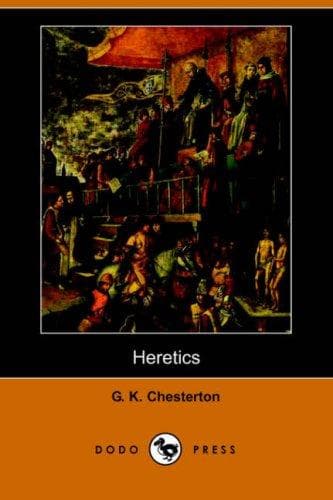
Apologetics; Chesterton, G. K. (Gilbert Keith), 1874-1936
All this, however, is a parenthesis. The thing with which I am here
immediately concerned is Mr. McCabe’s appeal to me not to be so
frivolous. Let me return to the actual text of that appeal. There are,
of course, a great many things that I might say about it in detail. But
I may start with saying that Mr. McCabe is in error in supposing that
the danger which I anticipate from the disappearance of religion is the
increase of sensuality. On the contrary, I should be inclined to
anticipate a decrease in sensuality, because I anticipate a decrease in
life. I do not think that under modern Western materialism we should
have anarchy. I doubt whether we should have enough individual valour
and spirit even to have liberty. It is quite an old-fashioned fallacy
to suppose that our objection to scepticism is that it removes the
discipline from life. Our objection to scepticism is that it removes
the motive power. Materialism is not a thing which destroys mere
restraint. Materialism itself is the great restraint. The McCabe
school advocates a political liberty, but it denies spiritual liberty.
That is, it abolishes the laws which could be broken, and substitutes
laws that cannot. And that is the real slavery.
The truth is that the scientific civilization in which Mr. McCabe
believes has one rather particular defect; it is perpetually tending to
destroy that democracy or power of the ordinary man in which Mr. McCabe
also believes. Science means specialism, and specialism means
oligarchy. If you once establish the habit of trusting particular men
to produce particular results in physics or astronomy, you leave the
door open for the equally natural demand that you should trust
particular men to do particular things in government and the coercing
of men. If, you feel it to be reasonable that one beetle should be the
only study of one man, and that one man the only student of that one
beetle, it is surely a very harmless consequence to go on to say that
politics should be the only study of one man, and that one man the only
student of politics. As I have pointed out elsewhere in this book, the
expert is more aristocratic than the aristocrat, because the aristocrat
is only the man who lives well, while the expert is the man who knows
better. But if we look at the progress of our scientific civilization
we see a gradual increase everywhere of the specialist over the popular
function. Once men sang together round a table in chorus; now one man
sings alone, for the absurd reason that he can sing better. If
scientific civilization goes on (which is most improbable) only one man
will laugh, because he can laugh better than the rest.
Public-domain text, read in full here on John Shaqi.
Reviews
Reviews
No reviews yet
Be the first to share your thoughts on this work.
Elsewhere in the archive
Join the Discussion
Join the discussion
Sign in to leave a comment or review.
Sign InorCreate an account