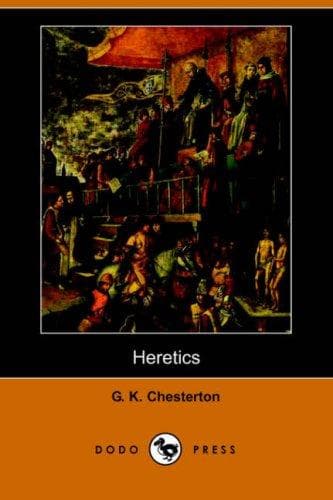
Apologetics; Chesterton, G. K. (Gilbert Keith), 1874-1936
Briefly, we may put the matter in this way. The main point of modern
life is not that the Alhambra ballet has its place in life. The main
point, the main enormous tragedy of modern life, is that Mr. McCabe has
not his place in the Alhambra ballet. The joy of changing and graceful
posture, the joy of suiting the swing of music to the swing of limbs,
the joy of whirling drapery, the joy of standing on one leg,—all these
should belong by rights to Mr. McCabe and to me; in short, to the
ordinary healthy citizen. Probably we should not consent to go through
these evolutions. But that is because we are miserable moderns and
rationalists. We do not merely love ourselves more than we love duty;
we actually love ourselves more than we love joy.
When, therefore, Mr. McCabe says that he gives the Alhambra dances (and
my articles) their place in life, I think we are justified in pointing
out that by the very nature of the case of his philosophy and of his
favourite civilization he gives them a very inadequate place. For (if I
may pursue the too flattering parallel) Mr. McCabe thinks of the
Alhambra and of my articles as two very odd and absurd things, which
some special people do (probably for money) in order to amuse him. But
if he had ever felt himself the ancient, sublime, elemental, human
instinct to dance, he would have discovered that dancing is not a
frivolous thing at all, but a very serious thing. He would have
discovered that it is the one grave and chaste and decent method of
expressing a certain class of emotions. And similarly, if he had ever
had, as Mr. Shaw and I have had, the impulse to what he calls paradox,
he would have discovered that paradox again is not a frivolous thing,
but a very serious thing. He would have found that paradox simply means
a certain defiant joy which belongs to belief. I should regard any
civilization which was without a universal habit of uproarious dancing
as being, from the full human point of view, a defective civilization.
And I should regard any mind which had not got the habit in one form or
another of uproarious thinking as being, from the full human point of
view, a defective mind. It is vain for Mr. McCabe to say that a ballet
is a part of him. He should be part of a ballet, or else he is only
part of a man. It is in vain for him to say that he is “not quarrelling
with the importation of humour into the controversy.” He ought himself
to be importing humour into every controversy; for unless a man is in
part a humorist, he is only in part a man. To sum up the whole matter
very simply, if Mr. McCabe asks me why I import frivolity into a
discussion of the nature of man, I answer, because frivolity is a part
of the nature of man. If he asks me why I introduce what he calls
paradoxes into a philosophical problem, I answer, because all
philosophical problems tend to become paradoxical. If he objects to my
treating of life riotously, I reply that life is a riot. And I say
Public-domain text, read in full here on John Shaqi.
Reviews
Reviews
No reviews yet
Be the first to share your thoughts on this work.
Elsewhere in the archive
Join the Discussion
Join the discussion
Sign in to leave a comment or review.
Sign InorCreate an account