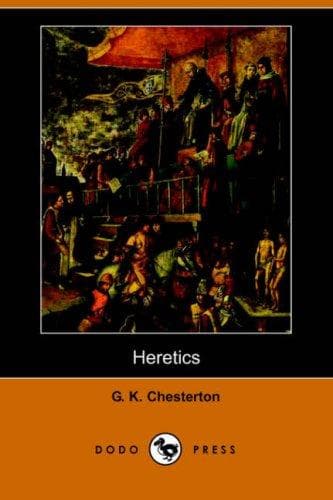
Apologetics; Chesterton, G. K. (Gilbert Keith), 1874-1936
No one will blame Professor Raleigh, who had to read a sort of funeral
oration over Whistler at the opening of the Memorial Exhibition, if,
finding himself in that position, he confined himself mostly to the
merits and the stronger qualities of his subject. We should naturally
go to some other type of composition for a proper consideration of the
weaknesses of Whistler. But these must never be omitted from our view
of him. Indeed, the truth is that it was not so much a question of the
weaknesses of Whistler as of the intrinsic and primary weakness of
Whistler. He was one of those people who live up to their emotional
incomes, who are always taut and tingling with vanity. Hence he had no
strength to spare; hence he had no kindness, no geniality; for
geniality is almost definable as strength to spare. He had no god-like
carelessness; he never forgot himself; his whole life was, to use his
own expression, an arrangement. He went in for “the art of living”—a
miserable trick. In a word, he was a great artist; but emphatically not
a great man. In this connection I must differ strongly with Professor
Raleigh upon what is, from a superficial literary point of view, one of
his most effective points. He compares Whistler’s laughter to the
laughter of another man who was a great man as well as a great artist.
“His attitude to the public was exactly the attitude taken up by Robert
Browning, who suffered as long a period of neglect and mistake, in
those lines of ‘The Ring and the Book’—
“‘Well, British Public, ye who like me not,
(God love you!) and will have your proper laugh
At the dark question; laugh it! I’d laugh first.’
“Mr. Whistler,” adds Professor Raleigh, “always laughed first.” The
truth is, I believe, that Whistler never laughed at all. There was no
laughter in his nature; because there was no thoughtlessness and
self-abandonment, no humility. I cannot understand anybody reading
“The Gentle Art of Making Enemies” and thinking that there is any
laughter in the wit. His wit is a torture to him. He twists himself
into arabesques of verbal felicity; he is full of a fierce carefulness;
he is inspired with the complete seriousness of sincere malice. He
hurts himself to hurt his opponent. Browning did laugh, because
Browning did not care; Browning did not care, because Browning was a
great man. And when Browning said in brackets to the simple, sensible
people who did not like his books, “God love you!” he was not sneering
in the least. He was laughing—that is to say, he meant exactly what he
said.
Public-domain text, read in full here on John Shaqi.
Reviews
Reviews
No reviews yet
Be the first to share your thoughts on this work.
Elsewhere in the archive
Join the Discussion
Join the discussion
Sign in to leave a comment or review.
Sign InorCreate an account