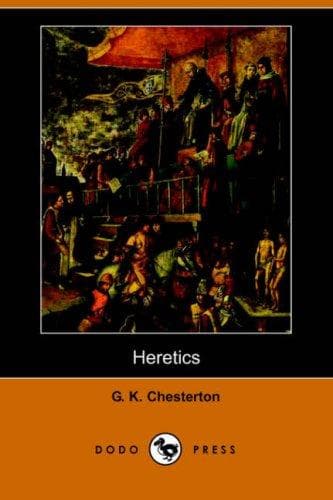
Apologetics; Chesterton, G. K. (Gilbert Keith), 1874-1936
To say that a man is an idealist is merely to say that he is a man;
but, nevertheless, it might be possible to effect some valid
distinction between one kind of idealist and another. One possible
distinction, for instance, could be effected by saying that humanity is
divided into conscious idealists and unconscious idealists. In a
similar way, humanity is divided into conscious ritualists and
unconscious ritualists. The curious thing is, in that example as in
others, that it is the conscious ritualism which is comparatively
simple, the unconscious ritual which is really heavy and complicated.
The ritual which is comparatively rude and straightforward is the
ritual which people call “ritualistic.” It consists of plain things
like bread and wine and fire, and men falling on their faces. But the
ritual which is really complex, and many coloured, and elaborate, and
needlessly formal, is the ritual which people enact without knowing it.
It consists not of plain things like wine and fire, but of really
peculiar, and local, and exceptional, and ingenious things—things like
door-mats, and door-knockers, and electric bells, and silk hats, and
white ties, and shiny cards, and confetti. The truth is that the modern
man scarcely ever gets back to very old and simple things except when
he is performing some religious mummery. The modern man can hardly get
away from ritual except by entering a ritualistic church. In the case
of these old and mystical formalities we can at least say that the
ritual is not mere ritual; that the symbols employed are in most cases
symbols which belong to a primary human poetry. The most ferocious
opponent of the Christian ceremonials must admit that if Catholicism
had not instituted the bread and wine, somebody else would most
probably have done so. Any one with a poetical instinct will admit that
to the ordinary human instinct bread symbolizes something which cannot
very easily be symbolized otherwise; that wine, to the ordinary human
instinct, symbolizes something which cannot very easily be symbolized
otherwise. But white ties in the evening are ritual, and nothing else
but ritual. No one would pretend that white ties in the evening are
primary and poetical. Nobody would maintain that the ordinary human
instinct would in any age or country tend to symbolize the idea of
evening by a white necktie. Rather, the ordinary human instinct would,
I imagine, tend to symbolize evening by cravats with some of the
colours of the sunset, not white neckties, but tawny or crimson
neckties—neckties of purple or olive, or some darkened gold. Mr. J.
A. Kensit, for example, is under the impression that he is not a
ritualist. But the daily life of Mr. J. A. Kensit, like that of any
ordinary modern man, is, as a matter of fact, one continual and
compressed catalogue of mystical mummery and flummery. To take one
instance out of an inevitable hundred: I imagine that Mr. Kensit takes
Public-domain text, read in full here on John Shaqi.
Reviews
Reviews
No reviews yet
Be the first to share your thoughts on this work.
Elsewhere in the archive
Join the Discussion
Join the discussion
Sign in to leave a comment or review.
Sign InorCreate an account