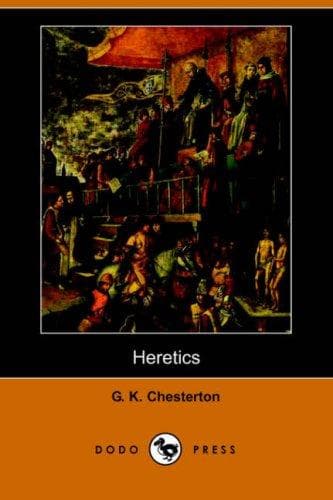
Apologetics; Chesterton, G. K. (Gilbert Keith), 1874-1936
And when we come actually to examine the main stock notions of our
modern practical politicians, we find that those main stock notions are
mainly delusions. A great many instances might be given of the fact.
We might take, for example, the case of that strange class of notions
which underlie the word “union,” and all the eulogies heaped upon it.
Of course, union is no more a good thing in itself than separation is a
good thing in itself. To have a party in favour of union and a party
in favour of separation is as absurd as to have a party in favour of
going upstairs and a party in favour of going downstairs. The question
is not whether we go up or down stairs, but where we are going to, and
what we are going, for? Union is strength; union is also weakness. It
is a good thing to harness two horses to a cart; but it is not a good
thing to try and turn two hansom cabs into one four-wheeler. Turning
ten nations into one empire may happen to be as feasible as turning ten
shillings into one half-sovereign. Also it may happen to be as
preposterous as turning ten terriers into one mastiff. The question in
all cases is not a question of union or absence of union, but of
identity or absence of identity. Owing to certain historical and moral
causes, two nations may be so united as upon the whole to help each
other. Thus England and Scotland pass their time in paying each other
compliments; but their energies and atmospheres run distinct and
parallel, and consequently do not clash. Scotland continues to be
educated and Calvinistic; England continues to be uneducated and happy.
But owing to certain other Moral and certain other political causes,
two nations may be so united as only to hamper each other; their lines
do clash and do not run parallel. Thus, for instance, England and
Ireland are so united that the Irish can sometimes rule England, but
can never rule Ireland. The educational systems, including the last
Education Act, are here, as in the case of Scotland, a very good test
of the matter. The overwhelming majority of Irishmen believe in a
strict Catholicism; the overwhelming majority of Englishmen believe in
a vague Protestantism. The Irish party in the Parliament of Union is
just large enough to prevent the English education being indefinitely
Protestant, and just small enough to prevent the Irish education being
definitely Catholic. Here we have a state of things which no man in his
senses would ever dream of wishing to continue if he had not been
bewitched by the sentimentalism of the mere word “union.”
Public-domain text, read in full here on John Shaqi.
Reviews
Reviews
No reviews yet
Be the first to share your thoughts on this work.
Elsewhere in the archive
Join the Discussion
Join the discussion
Sign in to leave a comment or review.
Sign InorCreate an account