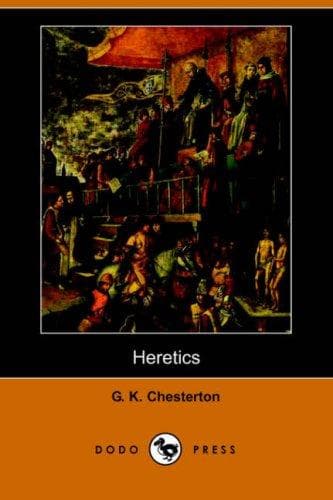
Apologetics; Chesterton, G. K. (Gilbert Keith), 1874-1936
Next to a genuine republic, the most democratic thing in the world is a
hereditary despotism. I mean a despotism in which there is absolutely
no trace whatever of any nonsense about intellect or special fitness
for the post. Rational despotism—that is, selective despotism—is
always a curse to mankind, because with that you have the ordinary man
misunderstood and misgoverned by some prig who has no brotherly respect
for him at all. But irrational despotism is always democratic, because
it is the ordinary man enthroned. The worst form of slavery is that
which is called Caesarism, or the choice of some bold or brilliant man
as despot because he is suitable. For that means that men choose a
representative, not because he represents them, but because he does
not. Men trust an ordinary man like George III or William IV. because
they are themselves ordinary men and understand him. Men trust an
ordinary man because they trust themselves. But men trust a great man
because they do not trust themselves. And hence the worship of great
men always appears in times of weakness and cowardice; we never hear of
great men until the time when all other men are small.
Hereditary despotism is, then, in essence and sentiment democratic
because it chooses from mankind at random. If it does not declare that
every man may rule, it declares the next most democratic thing; it
declares that any man may rule. Hereditary aristocracy is a far worse
and more dangerous thing, because the numbers and multiplicity of an
aristocracy make it sometimes possible for it to figure as an
aristocracy of intellect. Some of its members will presumably have
brains, and thus they, at any rate, will be an intellectual aristocracy
within the social one. They will rule the aristocracy by virtue of
their intellect, and they will rule the country by virtue of their
aristocracy. Thus a double falsity will be set up, and millions of the
images of God, who, fortunately for their wives and families, are
neither gentlemen nor clever men, will be represented by a man like Mr.
Balfour or Mr. Wyndham, because he is too gentlemanly to be called
merely clever, and just too clever to be called merely a gentleman. But
even an hereditary aristocracy may exhibit, by a sort of accident, from
time to time some of the basically democratic quality which belongs to
a hereditary despotism. It is amusing to think how much conservative
ingenuity has been wasted in the defence of the House of Lords by men
who were desperately endeavouring to prove that the House of Lords
consisted of clever men. There is one really good defence of the House
of Lords, though admirers of the peerage are strangely coy about using
it; and that is, that the House of Lords, in its full and proper
strength, consists of stupid men. It really would be a plausible
defence of that otherwise indefensible body to point out that the
clever men in the Commons, who owed their power to cleverness, ought in
Public-domain text, read in full here on John Shaqi.
Reviews
Reviews
No reviews yet
Be the first to share your thoughts on this work.
Elsewhere in the archive
Join the Discussion
Join the discussion
Sign in to leave a comment or review.
Sign InorCreate an account