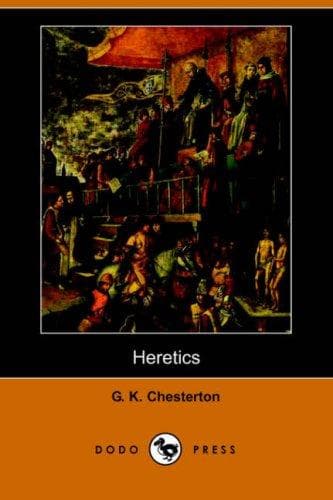
Apologetics; Chesterton, G. K. (Gilbert Keith), 1874-1936
As the word “unreasonable” is open to misunderstanding, the matter may
be more accurately put by saying that each one of these Christian or
mystical virtues involves a paradox in its own nature, and that this is
not true of any of the typically pagan or rationalist virtues. Justice
consists in finding out a certain thing due to a certain man and giving
it to him. Temperance consists in finding out the proper limit of a
particular indulgence and adhering to that. But charity means
pardoning what is unpardonable, or it is no virtue at all. Hope means
hoping when things are hopeless, or it is no virtue at all. And faith
means believing the incredible, or it is no virtue at all.
It is somewhat amusing, indeed, to notice the difference between the
fate of these three paradoxes in the fashion of the modern mind.
Charity is a fashionable virtue in our time; it is lit up by the
gigantic firelight of Dickens. Hope is a fashionable virtue to-day;
our attention has been arrested for it by the sudden and silver trumpet
of Stevenson. But faith is unfashionable, and it is customary on every
side to cast against it the fact that it is a paradox. Everybody
mockingly repeats the famous childish definition that faith is “the
power of believing that which we know to be untrue.” Yet it is not one
atom more paradoxical than hope or charity. Charity is the power of
defending that which we know to be indefensible. Hope is the power of
being cheerful in circumstances which we know to be desperate. It is
true that there is a state of hope which belongs to bright prospects
and the morning; but that is not the virtue of hope. The virtue of hope
exists only in earthquake and, eclipse. It is true that there is a
thing crudely called charity, which means charity to the deserving
poor; but charity to the deserving is not charity at all, but justice.
It is the undeserving who require it, and the ideal either does not
exist at all, or exists wholly for them. For practical purposes it is
at the hopeless moment that we require the hopeful man, and the virtue
either does not exist at all, or begins to exist at that moment.
Exactly at the instant when hope ceases to be reasonable it begins to
be useful. Now the old pagan world went perfectly straightforward until
it discovered that going straightforward is an enormous mistake. It was
nobly and beautifully reasonable, and discovered in its death-pang this
lasting and valuable truth, a heritage for the ages, that
reasonableness will not do. The pagan age was truly an Eden or golden
age, in this essential sense, that it is not to be recovered. And it is
not to be recovered in this sense again that, while we are certainly
jollier than the pagans, and much more right than the pagans, there is
not one of us who can, by the utmost stretch of energy, be so sensible
as the pagans. That naked innocence of the intellect cannot be
recovered by any man after Christianity; and for this excellent reason,
Public-domain text, read in full here on John Shaqi.
Reviews
Reviews
No reviews yet
Be the first to share your thoughts on this work.
Elsewhere in the archive
Join the Discussion
Join the discussion
Sign in to leave a comment or review.
Sign InorCreate an account