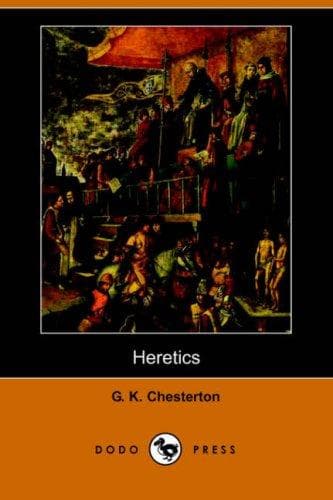
Apologetics; Chesterton, G. K. (Gilbert Keith), 1874-1936
that every man after Christianity knows it to be misleading. Let me
take an example, the first that occurs to the mind, of this impossible
plainness in the pagan point of view. The greatest tribute to
Christianity in the modern world is Tennyson’s “Ulysses.” The poet
reads into the story of Ulysses the conception of an incurable desire
to wander. But the real Ulysses does not desire to wander at all. He
desires to get home. He displays his heroic and unconquerable
qualities in resisting the misfortunes which baulk him; but that is
all. There is no love of adventure for its own sake; that is a
Christian product. There is no love of Penelope for her own sake; that
is a Christian product. Everything in that old world would appear to
have been clean and obvious. A good man was a good man; a bad man was
a bad man. For this reason they had no charity; for charity is a
reverent agnosticism towards the complexity of the soul. For this
reason they had no such thing as the art of fiction, the novel; for the
novel is a creation of the mystical idea of charity. For them a
pleasant landscape was pleasant, and an unpleasant landscape
unpleasant. Hence they had no idea of romance; for romance consists in
thinking a thing more delightful because it is dangerous; it is a
Christian idea. In a word, we cannot reconstruct or even imagine the
beautiful and astonishing pagan world. It was a world in which common
sense was really common.
My general meaning touching the three virtues of which I have spoken
will now, I hope, be sufficiently clear. They are all three
paradoxical, they are all three practical, and they are all three
paradoxical because they are practical. It is the stress of ultimate
need, and a terrible knowledge of things as they are, which led men to
set up these riddles, and to die for them. Whatever may be the meaning
of the contradiction, it is the fact that the only kind of hope that is
of any use in a battle is a hope that denies arithmetic. Whatever may
be the meaning of the contradiction, it is the fact that the only kind
of charity which any weak spirit wants, or which any generous spirit
feels, is the charity which forgives the sins that are like scarlet.
Whatever may be the meaning of faith, it must always mean a certainty
about something we cannot prove. Thus, for instance, we believe by
faith in the existence of other people.
Public-domain text, read in full here on John Shaqi.
Reviews
Reviews
No reviews yet
Be the first to share your thoughts on this work.
Elsewhere in the archive
Join the Discussion
Join the discussion
Sign in to leave a comment or review.
Sign InorCreate an account