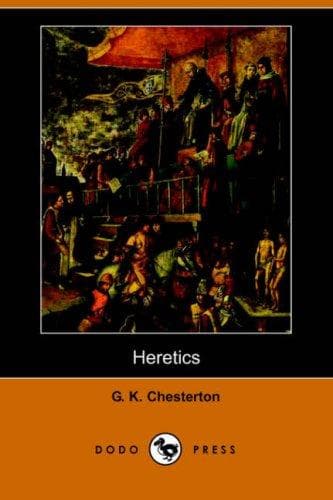
Apologetics; Chesterton, G. K. (Gilbert Keith), 1874-1936
When a wealthy nation like the English discovers the perfectly patent
fact that it is making a ludicrous mess of the government of a poorer
nation like the Irish, it pauses for a moment in consternation, and
then begins to talk about Celts and Teutons. As far as I can
understand the theory, the Irish are Celts and the English are Teutons.
Of course, the Irish are not Celts any more than the English are
Teutons. I have not followed the ethnological discussion with much
energy, but the last scientific conclusion which I read inclined on the
whole to the summary that the English were mainly Celtic and the Irish
mainly Teutonic. But no man alive, with even the glimmering of a real
scientific sense, would ever dream of applying the terms “Celtic” or
“Teutonic” to either of them in any positive or useful sense.
That sort of thing must be left to people who talk about the
Anglo-Saxon race, and extend the expression to America. How much of the
blood of the Angles and Saxons (whoever they were) there remains in our
mixed British, Roman, German, Dane, Norman, and Picard stock is a
matter only interesting to wild antiquaries. And how much of that
diluted blood can possibly remain in that roaring whirlpool of America
into which a cataract of Swedes, Jews, Germans, Irishmen, and Italians
is perpetually pouring, is a matter only interesting to lunatics. It
would have been wiser for the English governing class to have called
upon some other god. All other gods, however weak and warring, at least
boast of being constant. But science boasts of being in a flux for
ever; boasts of being unstable as water.
And England and the English governing class never did call on this
absurd deity of race until it seemed, for an instant, that they had no
other god to call on. All the most genuine Englishmen in history would
have yawned or laughed in your face if you had begun to talk about
Anglo-Saxons. If you had attempted to substitute the ideal of race for
the ideal of nationality, I really do not like to think what they would
have said. I certainly should not like to have been the officer of
Nelson who suddenly discovered his French blood on the eve of
Trafalgar. I should not like to have been the Norfolk or Suffolk
gentleman who had to expound to Admiral Blake by what demonstrable ties
of genealogy he was irrevocably bound to the Dutch. The truth of the
whole matter is very simple. Nationality exists, and has nothing in the
world to do with race. Nationality is a thing like a church or a secret
society; it is a product of the human soul and will; it is a spiritual
product. And there are men in the modern world who would think anything
and do anything rather than admit that anything could be a spiritual
product.
Public-domain text, read in full here on John Shaqi.
Reviews
Reviews
No reviews yet
Be the first to share your thoughts on this work.
Elsewhere in the archive
Join the Discussion
Join the discussion
Sign in to leave a comment or review.
Sign InorCreate an account