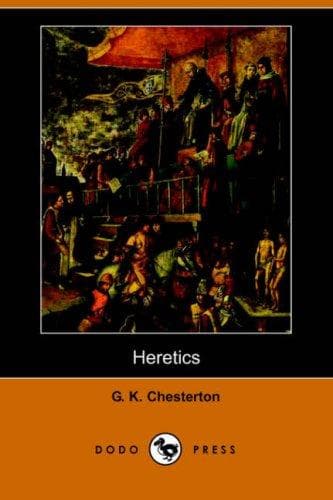
Apologetics; Chesterton, G. K. (Gilbert Keith), 1874-1936
The idea that there is something English in the repression of one’s
feelings is one of those ideas which no Englishman ever heard of until
England began to be governed exclusively by Scotchmen, Americans, and
Jews. At the best, the idea is a generalization from the Duke of
Wellington—who was an Irishman. At the worst, it is a part of that
silly Teutonism which knows as little about England as it does about
anthropology, but which is always talking about Vikings. As a matter of
fact, the Vikings did not repress their feelings in the least. They
cried like babies and kissed each other like girls; in short, they
acted in that respect like Achilles and all strong heroes the children
of the gods. And though the English nationality has probably not much
more to do with the Vikings than the French nationality or the Irish
nationality, the English have certainly been the children of the
Vikings in the matter of tears and kisses. It is not merely true that
all the most typically English men of letters, like Shakespeare and
Dickens, Richardson and Thackeray, were sentimentalists. It is also
true that all the most typically English men of action were
sentimentalists, if possible, more sentimental. In the great
Elizabethan age, when the English nation was finally hammered out, in
the great eighteenth century when the British Empire was being built up
everywhere, where in all these times, where was this symbolic stoical
Englishman who dresses in drab and black and represses his feelings?
Were all the Elizabethan palladins and pirates like that? Were any of
them like that? Was Grenville concealing his emotions when he broke
wine-glasses to pieces with his teeth and bit them till the blood
poured down? Was Essex restraining his excitement when he threw his hat
into the sea? Did Raleigh think it sensible to answer the Spanish guns
only, as Stevenson says, with a flourish of insulting trumpets? Did
Sydney ever miss an opportunity of making a theatrical remark in the
whole course of his life and death? Were even the Puritans Stoics? The
English Puritans repressed a good deal, but even they were too English
to repress their feelings. It was by a great miracle of genius
assuredly that Carlyle contrived to admire simultaneously two things so
irreconcilably opposed as silence and Oliver Cromwell. Cromwell was the
very reverse of a strong, silent man. Cromwell was always talking, when
he was not crying. Nobody, I suppose, will accuse the author of “Grace
Abounding” of being ashamed of his feelings. Milton, indeed, it might
be possible to represent as a Stoic; in some sense he was a Stoic, just
as he was a prig and a polygamist and several other unpleasant and
heathen things. But when we have passed that great and desolate name,
which may really be counted an exception, we find the tradition of
English emotionalism immediately resumed and unbrokenly continuous.
Whatever may have been the moral beauty of the passions of Etheridge
Public-domain text, read in full here on John Shaqi.
Reviews
Reviews
No reviews yet
Be the first to share your thoughts on this work.
Elsewhere in the archive
Join the Discussion
Join the discussion
Sign in to leave a comment or review.
Sign InorCreate an account