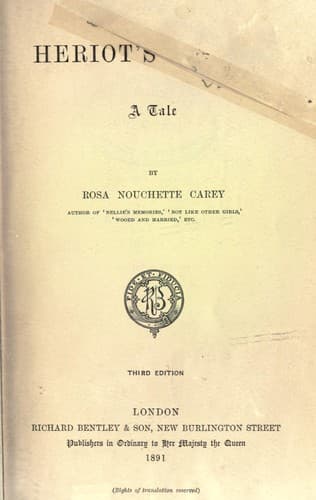
England -- Social life and customs -- 19th century -- Fiction; Families -- Fiction
Like many other narrow-minded men, Mr. Trelawny brooded over an idea
until it became fixed and ineradicable. Ethel's warm reception of Dr.
Heriot, and her evident pleasure in his society, were construed as so
many evidences of his own sagacity and her guilt. His only child and
heiress, for whom he had planned so splendid a future, intended to throw
herself away on a common country practitioner; she meant to disgrace
herself and him.
The wound rankled and became envenomed, steeping his whole soul in
bitterness and discontent. He was a disappointed man, he told
himself--disappointed in his ambition and in his domestic affections. He
had loved his wife, as such men love, next to himself; he had had a
certain pride in the possession of her, and though he had ever ruled her
with a rod of iron, he had mingled much fondness with his rule. But she
had left him, and the sons, who had been to him as the twin apples of
his eyes, had gone likewise. He had groaned and humbled himself beneath
that terrible stroke, and had for a little time walked softly as one who
has been smitten justly; and the pathos of his self-pity had been such
that others had been constrained to feel for him, though they marvelled
that his daughter, with the mother's eyes, had so little power to
comfort him.
There were times when he wondered also, when his veiled coldness showed
rents in it, and he owned to a certain pride in her that was not devoid
of tenderness.
For it was only of late that he had fallen into such carping ways, and
that the real breach was apparent. It was true Ethel had her mother's
eyes, but she lacked her mother's submissive gentleness; never a meek
woman, she had yet to learn the softness that disarms wrath. Her
open-eyed youth found flaws in everything that was not intrinsically
excellent. She canvassed men and manners with the warm injudiciousness
of undeveloped wisdom; acts were nothing, motives everything, and no
cleanness available that had a stain on its whiteness.
In place of the plastic girlhood he expected, Mr. Trelawny found himself
confronted by this daring and youthful Argus. He soon discovered Ethel's
inner sympathies were in open revolt against his. It galled him, even in
his pride, to see those clear, candid eyes measuring, half unconsciously
and half incredulously, the narrow limits of his nature. Whatever he
might seem to others, he knew his own child had weighed him in the
balance of her harsh-judging youth, and found him wanting.
Public-domain text, read in full here on John Shaqi.
Reviews
Reviews
No reviews yet
Be the first to share your thoughts on this work.
Elsewhere in the archive
Join the Discussion
Join the discussion
Sign in to leave a comment or review.
Sign InorCreate an account