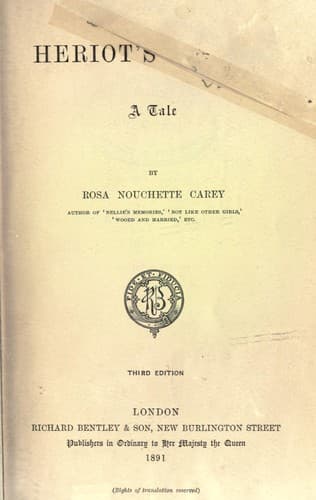
England -- Social life and customs -- 19th century -- Fiction; Families -- Fiction
He had called her Ethel for the first time since their old childish
days, and she had not noticed it. She offered no resistance as he
brought a soft fleecy shawl and wrapped it round her, and then gently
removed the white motionless fingers that were clutching the
window-frame; as they moved hand in hand over the grassy terrace, she
was quite unconscious of the firm, warm pressure; somewhere far away she
was thinking of a forlorn Ethel, whose father had spoken cruel words to
her. Richard was always good to her--always; there was nothing new in
that. Only once she turned and smiled at her favourite, with a smile so
sad and sweet that it almost broke his heart.
'How kind you are; you always take such care of me, Richard.'
'I wish I could--I wish I dare try,' he returned, in an odd, choked
voice. 'Let us go to your favourite seat, Ethel; the sun has not set
yet.'
'It has set for me to-night,' she replied, mournfully.
The creeping mists winding round the blue bases of the far-off hills
suited her better, she thought. She followed Richard mechanically into
the quaint kitchen garden; there was a broad terrace-walk, with a seat
placed so as to command the distant view; great bushes of cabbage-roses
and southernwood scented the air; gilly-flowers, and sweet-williams, and
old-fashioned stocks bloomed in the borders; below them the garden
sloped steeply to the crofts, and beyond lay the circling hills. In the
distance they could hear the faint pealing of the curfew bell, and the
bleating of the flocks in the crofts.
Ethel drew a deep sigh; the sweet calmness of the scene seemed to soothe
her.
'You were right to bring me here,' she said at last, gratefully.
'I have brought you here--because I want to speak to you,' returned
Richard, with the same curious break in his voice.
His temples were beating still, but he was calm, strangely calm, he
remembered afterwards. How did it happen? were the words his own or
another's? How did it come that she was shrinking away from him with
that startled look in her eyes, and that he was speaking in that low,
passionate voice? Was it this he meant when he called her Ethel?
'No, no! say you do not mean it, Richard! Oh, Richard, Richard!' her
voice rising into a perfect cry of pain. What, must she lose him too?
'Dear, how can I say it? I have always meant to tell you--always; it is
not my fault that I have loved you, Ethel; the love has grown up and
become a part of myself ever since we were children together!'
'Does Mildred--does any one know?' she asked, and a vivid crimson
mantled in her pale cheeks as she asked the question.
'Yes, my father knows--and Aunt Milly. I think they all guessed my
secret long ago--all but you,' in a tenderly reproachful voice; 'why
should they not know? I am not ashamed of it,' continued the young man,
a little loftily.
Somehow they had changed characters. It was Ethel who was timid now.
'But--but--they could not have approved,' she faltered at last.
Public-domain text, read in full here on John Shaqi.
Reviews
Reviews
No reviews yet
Be the first to share your thoughts on this work.
Elsewhere in the archive
Join the Discussion
Join the discussion
Sign in to leave a comment or review.
Sign InorCreate an account