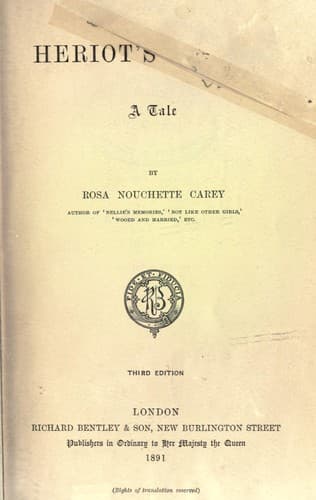
England -- Social life and customs -- 19th century -- Fiction; Families -- Fiction
Half--comforted, though his heart ached with its mighty burden of love;
and though he would have given half his strong young years to hear her
say, 'I love you, Richard.' Could older men love better, nay, half as
well as he did, with such self-sacrificing purity and faith?
Yes, his pain was great, for delay and uncertainty are bitter to the
young, and they would fain cleave with impatient hand the veiled mystery
of life; but nevertheless his heart was strong within him, for though he
could not speak of his hope, for fear that others might call it
visionary, yet it stirred to the very foundation of his soul; for so
surely as he suffered now, he knew that one day he should call Ethel
Trelawny his wife.
When Richard was gone, and the household unobservant and occupied in its
own business, Mildred quietly fetched her shady hat, and went through
the field paths, bordered by tall grasses and great shining ox-eyed
daises, which led to the shrubberies of Kirkleatham.
The great house was blazing in the sunshine; Ethel's doves were cooing
from the tower; through the trees Mildred could see the glimmer of a
white gown; the basket-work chair was in its old place, under her
favourite acacia tree; the hills looked blue and misty in the distance.
Ethel turned very pale when she saw her friend, and there was visible
constraint in her manner.
'I did not expect you; you should not have come out in all this heat,
Mildred.'
'I knew you would scold me; but I have not seen you for nearly a week,
so I came through the tropics to look after you,' returned Mildred,
playfully. 'You are under my care now. Richard begged me to be good to
you,' she continued, more seriously.
A painful flush crossed Ethel's face; her eyelids dropped.
'You must not let this come between us, Ethel; it will make him more
unhappy than he is, and I fear,' speaking still more gravely, 'that
though he says so little about himself, that he must be very unhappy.'
Ethel tried ineffectually to control her emotion.
'I could not help it. You have no right to blame me, Mildred,' she said
in a low voice.
'No, you could not help it! Who blames you, dear?--not I, nor Richard.
It was not your fault, my poor Ethel, that you could not love your old
playmate. It is your misfortune and his, that is all.'
'I know how good he is,' returned Ethel, with downcast eyes. Yes, it was
her misfortune, she knew; was he not brave and noble, her knight, _sans
peur_ and _sans reproche_, her lion-hearted Richard? Could any man be
more worthy of a woman's love?--and yet she had said him 'nay.' 'I know
he is good, too good,' she said, with a little spasm of fury against her
own hardness of heart, 'and I was a churl to refuse his love.'
Public-domain text, read in full here on John Shaqi.
Reviews
Reviews
No reviews yet
Be the first to share your thoughts on this work.
Elsewhere in the archive
Join the Discussion
Join the discussion
Sign in to leave a comment or review.
Sign InorCreate an account