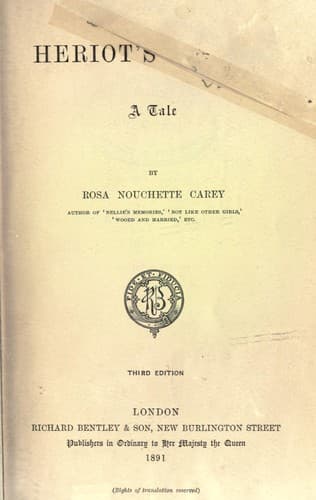
England -- Social life and customs -- 19th century -- Fiction; Families -- Fiction
'What! are there fashions in sheep-shearing?' asked Hugh, in an amused
tone. They were still standing by the little gate, under the shade of
some trees; before them were the farm-buildings and outhouses; and the
great ivied gateway, which led to the courtyard and house. Under the
gray walls were some small Scotch oxen; a peacock trailed its feathers
lazily in the dust. The air was resonant with the bleating of sheep and
lambs; the girls in their white dresses and broad-brimmed hats made a
pretty picture under the old elms. Mildred looked like a soft gray
shadow behind them.
'There are clippings and clippings,' returned Dr. Heriot, sententiously,
in answer to Hugh's half-amused and half-contemptuous question. 'This is
a very ordinary affair compared with that to which Polly refers.'
'How so?' asked Hugh, curiously.
'Owners of large stocks, I have been told, often have their sheep
clipped in sections, employ a certain number of men from day to day, and
provide a certain number of sheep, each clipper turning off seven or
eight sheep an hour.'
'Well, and the old-fashioned clipping?'
'Oh, that was another affair, and involved feasting and revelry. The
owner of a farm like this, for example, sets apart a special day, and
bids his friends and neighbours for miles round to assist him in the
work. It is generally considered that a man should clip threescore and
ten sheep in a day, a good clipper fourscore.'
'I thought the sheep-washing last month a very amusing sight.'
'Ah, Sowerby tells me that sheep improve more between washing and
clipping than at any other period of equal length. Have you ever seen
Best's _Farming Book_, two hundred years old? If you can master the old
spelling, it is very curious to read. It says there "that a man should
always forbear clipping his sheep till such time as he find their wool
indifferently well risen from the skin; and that for divers reasons."'
'Give us the reasons,' laughed Hugh. 'I believe if I were not in holy
orders I should prefer farming to any other calling.' And Dr. Heriot
drew out a thick notebook.
'I was struck with the quaintness, and copied the extract out verbatim.
This is what old Best says:--
'"I. When the wool is well risen from the skin the fleece is as
it were walked together on the top, and underneath it is but
lightly fastened to the undergrowth; and when a fleece is thus
it is called a mattrice coat.
'"II. When wool is thus risen there is no waste, for it comes
wholly off without any bits or locks.
'"III. Fleeces, when they are thus, are far more easy to wind
up, and also more easy for the clippers, for a man may almost
pull them off without any clipping at all.
'"IV. Sheep that have their wool thus risen have, without
question, a good undergrowth, whereby they will be better able
to endure a storm than those that have all taken away to the
very skin."
Public-domain text, read in full here on John Shaqi.
Reviews
Reviews
No reviews yet
Be the first to share your thoughts on this work.
Elsewhere in the archive
Join the Discussion
Join the discussion
Sign in to leave a comment or review.
Sign InorCreate an account