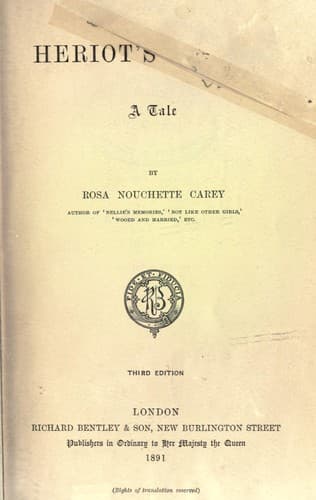
England -- Social life and customs -- 19th century -- Fiction; Families -- Fiction
In the distance the lambs were being dipped, and filled the air with
their distressful bleatings, refusing to recognise in the shorn,
miserable creatures that advanced to meet them the comfortable fleecy
parents they had left an hour ago.
Olive watched the heartrending spectacle till her heart grew pitiful.
The poor sheep themselves were baffled by the noxious sulphur with which
the fleece of the lambs were dripping. In the pasture there was
confusion, a mass of white shivering bodies, now and then ecstasies,
recognition, content. To her the whole thing was a living poem--the
innocent faces, the unrest, the plaintive misery, were intact with
higher meanings.
'This miserable little lamb, dirty and woebegone, cannot find its
mother,' she thought to herself. 'It is even braving the terrors of the
crowded yard to find her; even with these dumb, unreasoning creatures,
love casteth out fear.'
'Mr. Colby has been telling us such a curious thing,' said Hugh, coming
to her side, and speaking with his usual loud-voiced animation. 'He says
that in the good old times the Fell clergy always attended these
clippings, and acted the part of "doctor;" I mean applied the tar to the
wounded sheep.'
'Colby has rather a racy anecdote on that subject,' observed Dr. Heriot,
overhearing him. 'Let's have it, Michael, while your wife's tea is
brewing. By the bye, I have not tasted your "clipping ale" yet.'
'All right, doctor, it is to the fore. If the story you mean concerns
the election of a minister, I think I remember it.'
'Of course you do; two of the electors were discussing the merits of the
rival candidates, one of whom had preached his trial sermon that day.'
Michael Colby rubbed his head thoughtfully.
'Ay, ay; now I mind.'
'"Ay," says one, "a varra good sarmon, John; I think he'll du."'
'"Du," says John; "ay, fer a Sunday priest, I'll grant ye, he's aw weel
enugh; byt fer clippens en kirsnens toder 'ill bang him aw't nowt."'
Mildred was no longer able to conceal that her head ached severely, and,
at a whispered request from Polly, Dr. Heriot led the way to the
farmhouse.
Strangers, seeing Wharton Hall for the first time, are always struck by
the beauty of the old gateway, mantled in ivy, through which is the trim
flower-bordered inclosure, with its comfortable dwelling-house and low,
long dairy, and its picturesque remnant of ruins, the whole forming
three sides of a quadrangle.
Wharton Hall itself was built by Thomas Lord Wharton about the middle of
the sixteenth century, and is a good specimen of a house of the period.
Part of it is now in ruins, a portion of it occupied as a farmhouse.
Mrs. Colby, a trim, natty-looking little body, was bustling about the
great kitchen with her maids. Tea was not quite ready, and there was a
short interval of waiting, in a long, narrow room upstairs, with a great
window, looking over the dairy and garden, and the beautiful old
gateway.
Public-domain text, read in full here on John Shaqi.
Reviews
Reviews
No reviews yet
Be the first to share your thoughts on this work.
Elsewhere in the archive
Join the Discussion
Join the discussion
Sign in to leave a comment or review.
Sign InorCreate an account