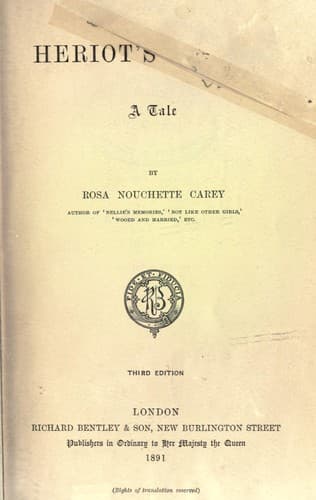
England -- Social life and customs -- 19th century -- Fiction; Families -- Fiction
'No, I am only tired,' returned Olive, a little weary of the mirth and
longing for quiet.
When the others had gone she stole up the crazy stairs and stood for a
long time in the great window looking at the old gateway. They all
wondered where she was, when Hugh found her and brought her down, and
they walked home through the gray glimmering fields.
'I wonder of what you were thinking when I came in and startled you?'
asked Hugh presently.
'I don't know--at least I cannot tell you,' returned Olive, blushing in
the dusky light. Could she tell any one the wonderful thoughts that
sometimes came to her at such hours; would he understand it if she
could?
The young man looked disconcerted--almost hurt.
'You think I should not understand,' he returned, a little piqued, in
spite of his sweet temper; 'you have never forgiven me my scepticism
with regard to poetry. I thought you did not bear malice, Miss Olive.'
'Neither do I,' she returned, distressed. 'I was only sorry for you
then, and I am sorry now you miss so much; poetry is like music, you
know, and seems to harmonise and go with everything.'
'Nature has made me prosaic and stupid, I suppose,' returned Hugh,
almost sorrowfully. He did not like to be told that he could not
understand; he had a curious notion that he would like to know the
thoughts that had made her eyes so soft and shining; it seemed strange
to him that any girl should dwell so apart in a world of her own. 'How
you must despise me,' he said at last, with a touch of bitterness, 'for
being what I am.'
'Hush, Mr. Marsden, how can you talk so?' returned Olive in a voice of
rebuke.
The idea shocked her. What were her beautiful thoughts compared to his
deeds--her dreamy, contemplative life contrasted with his intense
working energies? As she looked up at the great broad-shouldered young
fellow striding beside her, with swinging arms and great voice, and
simple boyish face, it came upon her that perhaps his was the very
essence of poetry, the entire harmony of mind and will with the work
that was planned for him.
'Oh, Mr. Marsden, you must never say that again,' she said earnestly, so
that Hugh was mollified.
And then, as was often the case with the foolish-fond fellow, when he
could get a listener, he descanted eagerly about his little Croydon
house and his mother and sisters. Olive was always ready to hear what
interested people; she thought Hugh was not without a certain homely
poetry as she listened--perhaps the moonlight, the glimmering fields, or
Olive's soft sympathy inspired him; but he made her see it all.
The little old house, with its faded carpet and hangings, and its
cupboards of blue dragon-china--'bogie-china' as they had called it in
their childhood--the old-fashioned country town, the gray old
almshouses, Church Street, steep and winding, and the old church with
its square tower, and four poplar trees--yes, she could see it all.
Public-domain text, read in full here on John Shaqi.
Reviews
Reviews
No reviews yet
Be the first to share your thoughts on this work.
Elsewhere in the archive
Join the Discussion
Join the discussion
Sign in to leave a comment or review.
Sign InorCreate an account