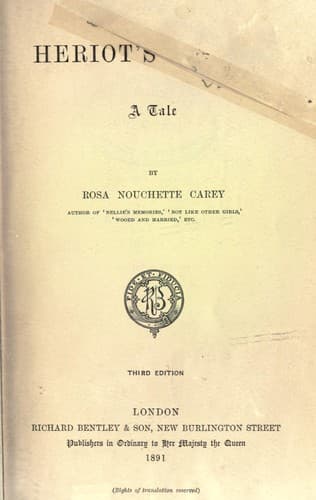
England -- Social life and customs -- 19th century -- Fiction; Families -- Fiction
Dr. Heriot seemed in no hurry to explain himself; he sat throwing
pebbles absently into the watery fissures at their feet, while Mildred
watched him with some anxiety. Time had dealt very gently with Dr.
Heriot; he looked still young, in the prime of life. A close observer
might notice that the closely-cropped hair was sprinkled with gray, but
the lines that trouble had drawn were almost effaced by the kindly hand
of time. There was still a melancholy shade in the eyes, an occasional
dash of bitterness in the kind voice, but the trouble lay far back and
hidden; and it could not be denied that Dr. Heriot was visibly happier
than he had been three years ago. Yes, it was true, sympathy bad
smoothed out many a furrow; kindly fellowship and close intimacy had
brightened the life of the lonely man; little discrepancies and angles
had vanished under beneficent treatment. The young fresh lives around
him, with their passionate interests, their single-eyed pursuits, lent
him new interests, and fostered that superabundant benevolence; and Hope
and its twin-sister Desire bloomed by the side of his desolate hearth.
Dr. Heriot had ever told himself that passion was dead within him, slain
by that deadly disgust and terror of years. 'A man cannot love twice as
I loved Margaret,' he had said to his friend more than once; and the two
men, drawn together by a loss so similar, and yet so diverse, had owned
that in their case, and with their faithful tenacity, no second love
could be possible.
'But you are a comparatively young man; you are in the very prime of
life, Heriot; you ought to marry,' his friend had said to him once.
'I do not care to marry for friendship and companionship,' he had
answered. 'My wife must be everything or nothing to me. I must love with
passion or not at all.' And there had risen up before his mind the
dreary spectacle of a degraded beauty that he once had worshipped, and
which had power to charm him to the very last.
It was three years since Dr. Heriot had uttered his bitter protest
against matrimony, and since then there had grown up in his heart a
certain sweet fancy, which had emanated first out of pure benevolence,
but which, while he cherished and fostered it, had grown very dear to
him.
He was thinking of it now, as the pebbles splashed harmlessly in the
narrow rivulets, while Mildred watched him, and thought with curious
incongruity of the dark, sunless pool lying behind the gray rocks, and
of the wild churning and seething of foamy waters which seemed to deaden
their voices; would he ever speak, she wondered. She sat with folded
hands, and a soft, perplexed smile on her face, as she waited, listening
to the dreamy rush of the water.
He roused himself at last in earnest.
'How good you are to me, Miss Lambert. After all, I have no right to tax
your forbearance.'
'All friends have a right,' was the low answer.
Public-domain text, read in full here on John Shaqi.
Reviews
Reviews
No reviews yet
Be the first to share your thoughts on this work.
Elsewhere in the archive
Join the Discussion
Join the discussion
Sign in to leave a comment or review.
Sign InorCreate an account