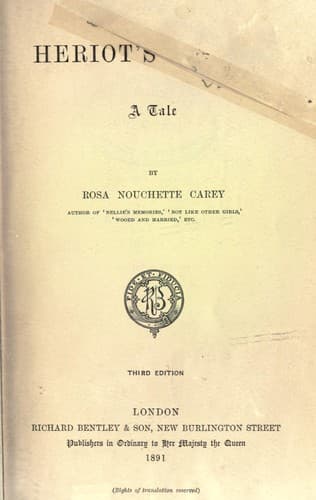
England -- Social life and customs -- 19th century -- Fiction; Families -- Fiction
'Indeed? I should like to know some of those thoughts,' with a playful
glance at her downcast face. 'I must positively hear them, Polly. How
sweet and still it is this evening. Suppose we sit and rest ourselves
for a little while, and you shall tell me all about them.'
Polly shook her head. 'They are not so easy to tell,' she said, looking
very shy all at once. Dr. Heriot had placed her on a stile at the head
of the little lane that skirted Podgill; the broad sunny meadow lay
before them, gemmed with trefoil and Polly's favourite eyebright; blue
gentian, and pink and white yarrow, and yellow ragwort, wove straggling
colours in the tangled hedgerows; the graceful campanula, with its
bell-like blossoms, gleamed here and there, towering above the lowlier
rose-campion, while meadow-sweet and trails of honeysuckle scented the
air.
Dr. Heriot leant against the fence with folded arms; his mood was sunny
and benignant. In his gray suit and straw hat he looked young, almost
handsome. Under the dark moustache his lip curled with an amused,
undefinable smile.
'I see you will want my help,' he said, with a sort of compassion and
amusement at her shyness. Whatever she might own, his little fearless
Polly was certainly afraid of him.
'I have tangled them dreadfully,' blushed Polly; 'the thoughts, I mean.
Every night when I go to bed I wish--I wish I were as wise as Aunt
Milly, and then perhaps I should satisfy you.'
'My dear child!' and then he stopped a little, amazed and perplexed. Why
was Mildred Lambert's goodness to be ever thrust on him, he thought,
with a man's natural impatience? He had not bent his neck to her mild
sway; her friendship was very precious to him--one of the good things
for which he daily thanked God; but this innocent harping on her name
fretted him with a vague sense of injury. 'Polly, who has put this in
your head?' he said; and there was a shadow of displeasure in his tone,
quiet as it was.
'No one,' she returned, in surprise; 'the thought has often come to me.
Are you never afraid,' she continued, timidly, but her young face grew
all at once sweet and earnest--'are you not afraid that you will be
tired--dreadfully tired--when you have only me to whom to talk?'
Then his gravity relaxed: the speech was so like Polly,--so like his
honest, simple-minded girl.
'And what if I were?' he repeated, playing with her fears.
'I should be so sorry,' she returned, seriously. 'No, I should be more
than sorry; I think it would make me unhappy. I should always be trying
to get older and wiser for your sake; and if I did not succeed I should
be ready to break my heart. No, do not smile,' as she caught a glimpse
of his amused face; 'I was never more serious in my life.'
'Why, Mary, my little darling, what is this?' he said, lifting the
little hand to his lips; for the bright eyes were full of tears now.
'No, call me Polly--I like that best,' she returned, hurriedly. 'Only my
father called me Mary; and from you----'
Public-domain text, read in full here on John Shaqi.
Reviews
Reviews
No reviews yet
Be the first to share your thoughts on this work.
Elsewhere in the archive
Join the Discussion
Join the discussion
Sign in to leave a comment or review.
Sign InorCreate an account