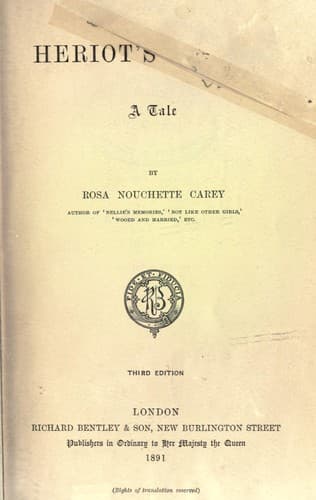
England -- Social life and customs -- 19th century -- Fiction; Families -- Fiction
'Hush, you must not talk,' he said, with a grave, professional air, 'and
you must drink this,' so authoritatively that Mildred could not choose
but to obey. 'It is nothing of consequence,' he continued, noticing an
anxious look on her face; 'the room was hot, and our talk wearied you. I
noticed you were very pale when we came in.' And Mildred felt relieved,
and asked no more questions.
She was very thankful for the kindness that shielded her from all
questioning and comment. When Dr. Heriot had watched the reviving
effects of the cordial, and had satisfied himself that there would be no
return of the faintness, he quietly but peremptorily desired that Polly
should leave her. 'You would like to be perfectly alone for a little
while, would you not?' he said, as he adjusted the rug over her feet and
placed the screen between her and the firelight, and Mildred thanked him
with a grateful glance. How could he guess that silence was what her
exhausted nerves craved more than anything?
But Dr. Heriot was not so impervious as he seemed. He was aware that
some nervous malady, caused by secret anxiety or hidden care, was
wasting Mildred's fine constitution. The dilated pupils of the eyes, the
repressed irritability of manner, the quick change of colour, with other
signs of mental disturbance, had long ago attracted his professional
notice, and he had racked his brains to discover the cause.
'She has over-exerted herself, or else she has some trouble,' he said to
himself that night, as he sat beside his solitary fire. She had crept
away to her own room during the interval of peace that had been allowed
her, and he had not suffered them to disturb her. 'I will come and see
her to-morrow,' he had said to Olive; 'let her be kept perfectly quiet
until then;' and Olive, who knew from experience the soothing effects of
his prescription, mounted guard herself over Mildred's room, and forbade
Polly or Chriss to enter.
Dr. Heriot had plenty of food for meditation that night. In spite of his
acquiescence in Polly's decision, he felt chilled and saddened by the
girl's persistence.
For the first time he gravely asked himself, Had he made a mistake? Was
she too young to understand his need of sympathy? Would it come to this,
that after all she would disappoint him? As he looked round the empty
room a strange bitterness came over him.
'And it is to this loneliness that she will doom me for another year,'
he said, and there was a heavy cloud on his brow as he said it. 'If she
really loved me, would she abandon me to another twelvemonth of
miserable retrospection, with only Margaret's dead face to haunt me with
its strange beauty?' But even as the thought passed through him came the
remembrance of those clinging arms and the dark eyes shining through
their tears.
'I love you dearly--dearly--but I want to love you more.'
Public-domain text, read in full here on John Shaqi.
Reviews
Reviews
No reviews yet
Be the first to share your thoughts on this work.
Elsewhere in the archive
Join the Discussion
Join the discussion
Sign in to leave a comment or review.
Sign InorCreate an account