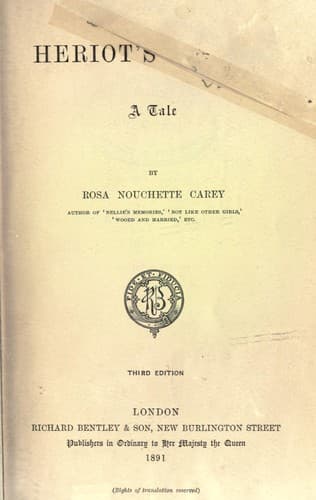
England -- Social life and customs -- 19th century -- Fiction; Families -- Fiction
What nightmare of oppression was on him? What light, scorching and
illuminating, was shining on him through the gloom? Was he losing his
senses?--had he dreamt it? Had he really heard it? 'John, save me,
John!' as of a woman in mortal anguish calling on her mate, as Margaret
had once--but once--called him, when a glimpse of the dark valley had
been vouchsafed her, and she had bidden him, with frenzied eye and
tongue, arrest her downward course: 'I cannot die--at least, not like
this--you must save me, John!' and that time he had saved her.
And now he had heard it again, at the only time when conventionality
lays aside its decorous disguise, and the souls of men are bare to their
fellows--at the time of awful peril on the brink of a momentarily
expected death: so had she called to him, and so, with the sudden waking
response of his soul, he had answered her.
He could see it all now. Never, to his dying hour, could he forget that
scene--the prostrate figure crashing among the rocks, as though to an
immediate and terrible death; the agonised struggle in the dark pit, the
white face pressed heavily like death to his shoulder, the long unbound
hair streaming across his arm; never before had he owned to himself that
this woman was fair, until he had put back the blinding hair with his
hand, as she clung to him in suffering helplessness.
'I wished to die, but I never knew how terrible death could be,' he had
heard her whisper between her quivering lips; and the knowledge that her
secret was his had bidden him turn away his eyes from her--his own
suffused with tears.
'Fool! blind fool that I was!' he groaned. 'Fool! never to guess how
dear she was until I saw death trying to snatch her from me; never to
know the reason why her presence inspired me with such comfort and such
rest! And I must needs call it friendship. Was it friendship that
brought me day after day with such a sore heart to minister to her
weakness?--was it only friendship and pity, and a generous wish to
succour her distress?
'Oh, fool! miserable fool! for ever fated to destroy my own peace of
mind!' But we need not follow the bitter self-communing of that generous
spirit through that long night of doubt and pain from which he rose a
sadder and a better man.
Alas! he had grasped the truth too late. The true woman, the true mate,
the very nature akin to his own, had been beside him all these years,
and he had not recognised her, blind in his pitiful worship of lesser
lights.
And as he thought of the innocent girl who had pledged her faith to him,
he groaned again within himself. Polly was not less dear to him in the
misery that had befallen him, yet he knew, and shuddered at the
knowledge, that all unwittingly he had deceived himself and her; he
would love his child-wife dearly, he knew, but not as he could love a
woman like Mildred.
Public-domain text, read in full here on John Shaqi.
Reviews
Reviews
No reviews yet
Be the first to share your thoughts on this work.
Elsewhere in the archive
Join the Discussion
Join the discussion
Sign in to leave a comment or review.
Sign InorCreate an account