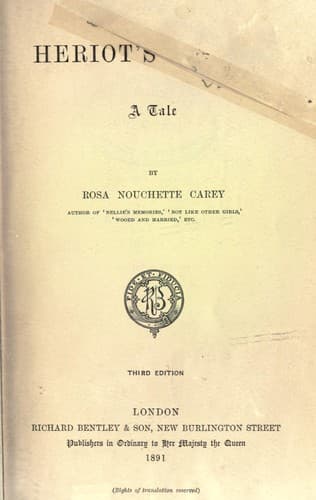
England -- Social life and customs -- 19th century -- Fiction; Families -- Fiction
But as he went out of the room, he told himself that these interviews
were perilously sweet, and must be avoided at all hazards; either he
must wound her with his coldness, or his tenderness would inevitably
betray itself in some unguarded look or word. Twice, already, had her
name lingered on his tongue, and more than one awkward pause had brought
her clear glances questioning to his face.
What right had he to hold the poor blackened hand in his for more than a
moment? But the sweet soul had taken it all so naturally; her colour had
never varied; possibly her great deliverance had swallowed all lesser
feelings for the time; the man she loved had become her preserver, and
this knowledge was so precious to her that it had lifted her out of her
deep despondency.
But as he set forth to his work, he owned within himself that such
things must not be--it were a stain on his integrity to suffer it; from
the first of Mildred's coming their intercourse had been free and
unrestrained, but for the future he would time his visits when the other
members of the family would be present, or, better still, he would keep
Polly by his side, trusting that the presence of his young betrothed
would give him the strength he needed.
Mildred did not seem to notice the change, it was effected so skilfully;
she was always better pleased when Olive or Polly was there--it diverted
Dr. Heriot's attention from herself, and caused her less embarrassment;
her battered frame was in sore need of rest, but with her usual
unselfishness, she resumed some of her old duties as soon as possible,
that Olive might not feel overburdened.
'It seems as though I have been idle for such a long time,' she said, in
answer to Dr. Heriot's deprecating glance at the mending beside her;
'Olive has no time now, and these things are more troublesome to her
than to most people. To-morrow I mean to take to housekeeping again, for
Polly feels herself quite unable to manage Nan.'
Dr. Heriot shook his head, but he did not directly forbid the
experiment. He knew that to a person of Mildred's active habits,
anything approaching to indolence was a positive crime; it was better
for them both that she should assert that she was well, and that he
should be free to relax his vigilance; he could still watch over her,
and interfere when it became necessary to do so.
Mildred had reason to be thankful that he did not oppose her exertions,
for before long fresh work came to her.
The very morning after Dr. Heriot had withdrawn his silent protest, a
letter in a strange handwriting was laid beside Mildred's
breakfast-plate; the postmark was London, and she opened it in some
little surprise; but Polly, who was watching her, noticed that she
turned pale over the contents.
'Is it about Roy?' she whispered; and Mildred started.
'Yes, he has been ill,' and she looked at her brother doubtfully; but he
stretched out his hand for the letter, and read it in silence.
Polly watched them anxiously.
Public-domain text, read in full here on John Shaqi.
Reviews
Reviews
No reviews yet
Be the first to share your thoughts on this work.
Elsewhere in the archive
Join the Discussion
Join the discussion
Sign in to leave a comment or review.
Sign InorCreate an account