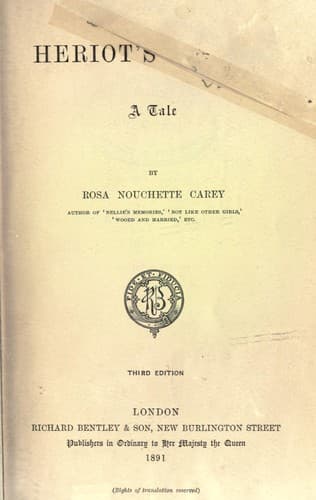
England -- Social life and customs -- 19th century -- Fiction; Families -- Fiction
By and by he began to talk, and then she laid down her work to listen.
Some strange chord of the past seemed stirred in the man's heart
to-night. All at once he mentioned his mother; her name was Mildred, he
said, looking into the embers as he spoke; and a little sister whom they
had lost in her childhood had been called Milly too. For their sakes the
name had always been dear to him. She was a good woman, he said, but her
one fault in his eyes had been that she had never loved Margaret; a
certain bitter scene between them had banished his widowed mother from
his house. Margaret had not understood her, and they were better apart;
but it had been a matter of grief to him.
And then he began to talk of his wife--at first hesitatingly--and then,
as Mildred's silent sympathy seemed to open the long-closed valves, the
repressed sorrow of years began to find vent. Well might Mildred marvel
at the secret strength that had sustained the generous heart in its long
struggle, at 'the charity that suffered so long.' What could there have
been about this woman, that even degradation and shame could not weaken
his faithful love, that even in his misery he should still pity and
cleave to her.
As though answering her thought, Dr. Heriot suddenly placed a miniature
in her hand.
'That was taken when I first saw her,' he said, softly; 'but it does not
do her justice; and then, one cannot reproduce that magnificent voice. I
have never heard a voice like it.'
Mildred bent over it for a moment without speaking; it was the face of a
girl taken in the first flush of her youth; but there was nothing
youthful in the face, which was full of a grave matured beauty.
The dark melancholy eyes seemed to rivet Mildred's; a wild sorrow lurked
in their inscrutable depths; the brow spoke intellect and power; the
mouth had a passionate, irresolute curve. As she looked at it she felt
that it was a face that might well haunt a man to his sorrow.
'It is beautiful--beautiful--but it oppresses me,' she said, laying it
down with a sigh. 'I cannot fancy it ever looking happy.'
'No,' he returned, with a stifled voice. 'Her one trouble embittered her
life. I never remember seeing her look really happy till I placed our
boy in her arms; he taught her to smile first, and then he died, and our
happiness died with him.'
'You must try to forget all this now,' she said, alluding to his
approaching marriage. 'It is not well to dwell upon so mournful a past.'
'You are right; I think I shall bury it from this night,' he returned,
with a singular smile. 'I feel as though you have done me good,
Mildred--Miss Lambert--but now I am selfishly keeping you up, after all
your nursing too. Good-night.'
He held her hand for a moment in both his; his eyes questioned the pale
worn face, anxiously, tenderly.
'When are you going to get stronger? You do me no credit,' he said,
sadly.
And his look and tone haunted her, in spite of her efforts. He had
called her Mildred too.
Public-domain text, read in full here on John Shaqi.
Reviews
Reviews
No reviews yet
Be the first to share your thoughts on this work.
Elsewhere in the archive
Join the Discussion
Join the discussion
Sign in to leave a comment or review.
Sign InorCreate an account