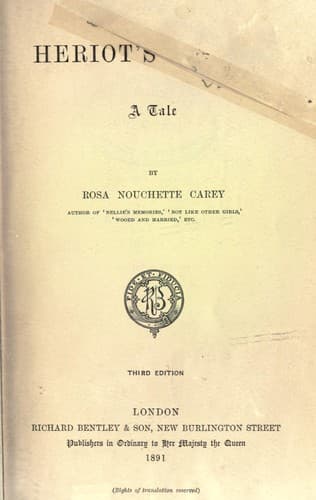
England -- Social life and customs -- 19th century -- Fiction; Families -- Fiction
Poor Polly, she stood irresolute, not daring to advance, or look up, and
wishing that the ground would swallow her.
'Polly--dear Polly--will you not come to me?' and Roy walked feebly to
meet her. Before she could move or answer, his arms were round her. 'My
Polly--my own now,' he cried, rapturously pressing her to him with weak
force; 'Heriot has given you to me.'
Polly looked up at her young lover shyly. Roy's face was flushed, his
eyes were shining with happiness, a half-proud, half-humble expression
lingered round his mouth; the arm that supported her trembled with
weakness.
'Oh, Rex, how wrong of me to let you stand,' she said, waking up from
her bewilderment; 'you must lie down, and I will take my old place
beside you.'
'Yes, he has given you the right to nurse me now,' whispered Roy, as she
arranged the cushions under his head. 'I am more than your adopted
brother now.' And Polly's happy blush was her only answer.
'You will never refuse to sing to me again?' he said presently, when
their agitation had a little subsided.
'No, and you will let me have my old ring,' she returned, softly. 'Oh,
Rex, I cried half the night, when you would not let me wear it. I never
cared so much for my beautiful diamonds.'
A misty smile crossed Roy's face.
'No, Polly, I never mean to part with it again. Look here,'--and he
showed her the garnets suspended to his watch-chain--'we will exchange
rings in the old German fashion, dear. I will keep the garnets, and I
will buy you the pearl hoop you admired so much; you must remember, you
have chosen only a poor artist.'
'Oh, Rex, how I shall glory in your pictures!' cried the girl,
breathlessly. 'I have always loved them for your sake, but now it will
be so different. They will be dearer than ever to me.'
'I never could have worked without you, Polly,' returned the young man,
humbly. 'I tried, but it was a miserable failure; it was your childish
praise that first made me seriously think of being an artist; and when
you failed me, all the spirit seemed to die out of me, just as the
sunshine fades out of a landscape, leaving nothing but a gray mist. Oh,
Polly, even you scarcely know how wretched you made me.'
'Do not let us talk of it,' she whispered, pressing closer to him; 'let
us only try to deserve our happiness.'
'That is what he said,' replied Roy, in a low voice. 'He told me that we
were very young to have such a responsibility laid upon us, and that we
must help each other. Oh, what a good man he is,' he continued, with
some emotion, 'and to think that at one time I almost hated him.'
'You could not help it,' she answered, shyly. To her there was no flaw
in her young lover; his impatience and jealousy, his hot and cold fits
that had so sorely tried her, his singular outbursts of temper, had only
been natural under the circumstances; she would have forgiven him harder
usage than that; but Roy judged himself more truly.
Public-domain text, read in full here on John Shaqi.
Reviews
Reviews
No reviews yet
Be the first to share your thoughts on this work.
Elsewhere in the archive
Join the Discussion
Join the discussion
Sign in to leave a comment or review.
Sign InorCreate an account