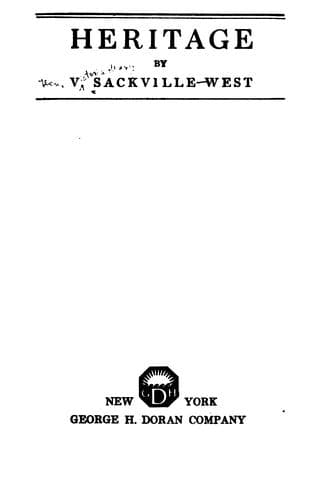
Eccentrics and eccentricities -- Fiction; Women -- Fiction
“We took the short cut to Westmacotts’. There it was, the lath and
plaster house, the farm buildings, the double oast-house at the corner
of the big black barn, simmering, hazy and mellow, in the summer
evening. A farm-hand, carrying a great truss of hay on a pitchfork
across his shoulder, touched his cap to Ruth as he passed. There was no
sign of Westmacott.
“‘Where ...’ I began, but changed my question. ‘Where are the children?’
“‘I left them over with mother before I came away this morning,’ she
answered.
“We went into the house, into the kitchen, the same kitchen, unchanged.
“She took refuge in practical matters.
“‘Will you wait there while I take off my things and get the tea?’
“I sat down like a man in a dream while she disappeared upstairs. I was
quite incapable of reflection, but dimly I recognised the difference
between this clean, happy room of bright colours and shining brasses,
and the tawdry, musty flat I had penetrated that morning, and the
contrast spread itself like ointment over a wound.
“Ruth returned; she had taken off her hat and had covered her London
clothes by a big blue linen apron with patch pockets. Her sleeves were
rolled up to the elbow; I saw the smooth brown arm with the delicate
wrist and shapely hand.
“‘You’ll want your tea,’ she said briskly.
“I had had nothing to eat since breakfast.
“You told me once in a letter that you had been to tea with Ruth, so you
know the kind of meal she provides: bread, honey, scones, big cups, and
tea in an enormous teapot. She laid two places only, moving about,
severely practical, but still quivering with that suppressed excitement,
still tense with that unfaltering determination.
“‘It’s ready,’ she said at length, summoning me.
“I couldn’t eat, for the emotion of that meal alone with her was too
strong for me. I sat absently stirring the sugar in my cup. She tried to
coax me to eat, but her solicitude exasperated my overstrained nerves,
and I got up abruptly.
“‘It’s no good,’ I said, ‘I must know. What is it, Ruth? What had you to
tell me?’
“The moment had rushed at her unawares; she looked at me with frightened
eyes; her determination, put to the test, hesitated.
“I went over to her and stood before her.
“‘What is it, Ruth?’ I said again. ‘You haven’t brought me down here for
nothing. Hadn’t you better tell me before your husband comes in?’
“‘He won’t come in,’ she said, hanging her head so that I could only see
the wealth of her hair and her little figure in the big blue apron.
“‘How do you know?’ I asked.
“‘He isn’t here.’
“‘Where is he, then?’
“She raised her head and looked me full in the face, no longer
frightened, but steady, resolute.
“‘He has left me,’ she said.
“‘Left you? What do you mean? For good?’
“‘Yes. He’s left me, the farm, and the children; he’s never coming
back.’
“‘But why? Good Heavens, why?’
“‘He was afraid,’ she said in a low voice.
“‘Afraid?’
“‘Yes. Of me. Oh,’ she broke off, ‘sit down and I will tell you all
about it.’
Public-domain text, read in full here on John Shaqi.
Reviews
Reviews
No reviews yet
Be the first to share your thoughts on this work.
Elsewhere in the archive
Join the Discussion
Join the discussion
Sign in to leave a comment or review.
Sign InorCreate an account