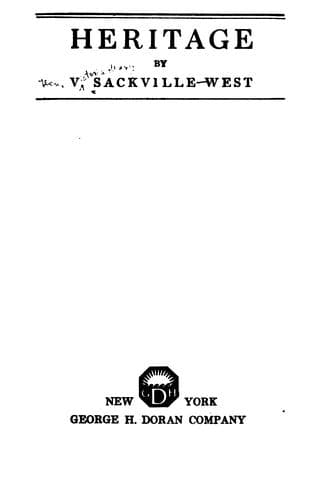
Eccentrics and eccentricities -- Fiction; Women -- Fiction
“But, suspicious now, she watched him closely, and he, realising that
she was watching him, tried to writhe away from her vigilance. He would
invent excuses to absent himself all day from the farm—a distant market,
a local show—and would return late at night, creeping unheard up to his
attic, there to slip off his clothes in the dark, or with the moonlight
streaming in through his little latticed, dormer window. So for days he
would contrive to meet his wife only at breakfast. His excuses were
always convincing, and in them she could find no flaw. She might not
have noticed his strange behaviour, but for the incident of the
re-arranged bedrooms, and perhaps some feminine instinct which had
stirred in her. She dared not question him, fearing a scene, but
gradually she came to the not unnatural conclusion that he was keeping a
second establishment where he spent most of his time.
“This left her indifferent; she had long since made her life independent
of his, and the possible gossip of neighbours did not touch her as it
would have touched a woman of commoner fibre. She had quite made up her
mind that Rawdon spent all his nights away from home, returning shortly
before she awoke in the morning. She did not resent this, especially as
he had shown himself much gentler towards her of late. She was even
vaguely sorry for him, that he should take so much trouble to conceal
his movements. It must be very wet, walking through the long dewy grass
of the fields so early in the morning.
“She was surprised to notice that his boots were never soaked through,
as she logically expected to find them.
“One night she lay awake, thinking over all these things, when an
impulse came to her, to go and look in his room. She got up quietly,
slipping on her shoes and dressing gown, and stole out on to the
landing. The house was dark and silent. She crept upstairs, and turned
the handle of his door, confident that she would find the room empty. By
the light of the moon, which poured down unimpeded by any curtain
through the little oblong window in the sloping roof, she saw her
husband’s dark, beautiful head on the white pillow. He was sleeping
profoundly. His clothes lay scattered about the floor, as he had thrown
them off.
“So surprised was she—a surprise amounting, not to relief, but almost to
dismay—that she stood gazing at him, holding the door open with her
hand. Sensitive people and children will often wake under the influence
of a prolonged gaze. Westmacott, who was a sensitive man beneath his
brutality, and who further was living just then, I imagine, in a state
of considerable nerve tension, woke abruptly with an involuntary cry as
from a nightmare. He sat up in bed, flinging back the clothes—sat up,
Ruth says, with staring eyes and the signs of terror stamped on all his
features.
“‘You! you!’ he said wildly, ‘what do you want with me? in God’s name
what do you want?’
“She thought him still half-asleep, and replied in a soothing voice,—
Public-domain text, read in full here on John Shaqi.
Reviews
Reviews
No reviews yet
Be the first to share your thoughts on this work.
Elsewhere in the archive
Join the Discussion
Join the discussion
Sign in to leave a comment or review.
Sign InorCreate an account