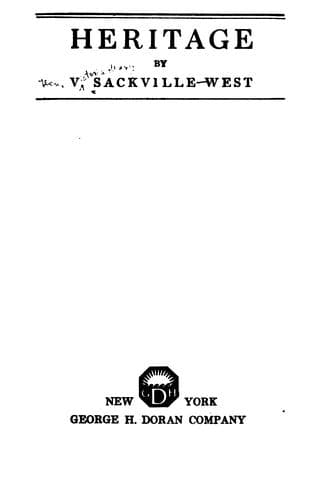
Eccentrics and eccentricities -- Fiction; Women -- Fiction
I folded my arms and leant my back against the house wall; I heard the
rise and fall of angry voices within the room; I found that I could look
only at little things, such as the cracks in the stone paving of the
garden path, or the latch on the gate, and that the horizon, when I
raised my eyes towards it, swam. I tried to drag back my failing sense
of proportions. As I did this, clinging on to and deliberately ranging
my thoughts in ordered formation, there emerged the dearness and
all-eclipsing importance of my scheme to me in the past; I realised that
never for a moment had it been absent from my conscious or my
sub-conscious thought. So, I said to myself, this is the phenomenon of
poets, and are they, I wonder, as passive as I am when after months of
carrying their purpose in their brain, the moment comes of its fruition?
Have they, like me, no feeling of control? I remembered what Malory had
said of the corelation of human effort.
I looked towards the darkened window and, hearing the drone of voices,
beheld myself again as the brother of the poet whose puppets, brought by
him to a certain point, continue to work along the lines he has laid
down, as though independent of his agency. I would resume control, I
thought, when this so terribly inevitable act had played itself out.
Then I would step in, lead Malory to Ruth, and again step out, leaving
them to the joy of their bewilderment.
Why should I have cherished this scheme so passionately? so passionately
that my desire had risen above my reason, carrying with it that strange
conviction that by the sheer force of my will events would shape
themselves—as indeed they were shaping—under my inactive hand? Why? I
could not explain, but as the twilight deepened rapidly in the garden I
saw again Malory’s grave, lean face, heard his half-sad, half-happy
comments, was pierced by the pitiable and unnecessary tragedy of his
loneliness—Malory away in France, unconscious of the intensity of the
situation created around him, without his knowledge and without his
consent, by a woman who loved him and a man who, I suppose, loved him
too.
It was at that moment, when I had worked myself up into a positive
exaltation, that I heard a sudden angry shout and a shot from a
revolver.
I awoke, and I confess that before rushing into the house I stood for a
dizzy second while a thousand impressions wheeled like a flock of
startled birds in my brain. It was over, then? Westmacott was dead, I
was sure of that. Would the mice, two miles away, be waltzing? I had an
insane desire to run over and look. Westmacott was dead; then I had
killed him, I was his murderer as much as if I stood in Ruth’s place
with the smoking revolver in my hand. It was over; the recent tradition
of war, where life was cheap, had joined with Concha’s legacy for the
fulfilment of my purpose. What a heritage! for that double heritage, not
fate, had helped me out. Blood, war, and I were fellow conspirators.
Public-domain text, read in full here on John Shaqi.
Reviews
Reviews
No reviews yet
Be the first to share your thoughts on this work.
Elsewhere in the archive
Join the Discussion
Join the discussion
Sign in to leave a comment or review.
Sign InorCreate an account