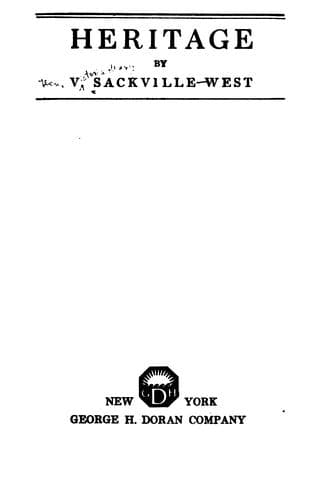
Eccentrics and eccentricities -- Fiction; Women -- Fiction
“There, my dear fellow, I profoundly apologise; if I oughtn’t to say
these things to my century I oughtn’t to say them to you either, not
that you are narrow enough to condemn me, but because I shall bore you.
I promised you, too, that my letter was to deal with our little corner
of Kent, and on that understanding I have induced you to read thus far.
I reflect, moreover, that I have no right to speak thus and thus to a
man who has lost much of his activity in his country’s service. Mrs.
Pennistan has drawn me a touching picture of you, though she hasn’t much
descriptive talent, has she? A motherly soul, pathetically out of place
among that untamed brood. Like the majority of people, she lives a life
of externals, with sentimentality as a mild substitute for the more
heroic things, and it has been her misfortune for her lot to fall among
people who, in the critical moments of their lives, allow themselves to
be guided by internal powers of which Mrs. Pennistan knows nothing. I
said, nothing. Yet is such true placidity possible? When you see a
person, a body, marvellous casket and mask of secrets, what do you
think? I think, there stands a figure labelled with a name, but he, or
she, has lived a certain number of years; that is to say, has suffered,
rejoiced, loved, been afraid, known pain; owns secrets, some dirty, some
natural, some shameful, some merely pathetic; and the older the figure,
the greater my wonderment and my admiration. Mrs. Pennistan, dull,
commonplace woman, once gave herself to Amos; was then that not an
immortal moment? But if she remembers at all, she remembers without
imagination; she can’t touch her recollection into life.
“And she dwells among hot, smouldering natures to whom the life of the
spirit is real. She doesn’t understand them, and when her daughter, who
is apparently living in externals likewise, breaks out into the
unexpected, she is perplexed, dismayed, aggrieved. She doesn’t travel on
parallel lines with the workings of such a mind as her daughter’s and
consequently has to catch up with a sudden leap forward which disturbs
her comfortable amble. She had to take such a leap when her daughter
eloped, and another similar leap when her daughter tried to shoot her
son-in-law. Humorous, isn’t it? and rather sad. I feel less for Amos,
whose instinct is more in tune with Ruth’s, and is able to follow
quickly by instinct if not by reason.
“At present Mrs. Pennistan’s mind must be in chaos, but it is happy
chaos, and so she accepts it without disproportionate bewilderment.
Besides, she has come by now to a fortunate state of resignation, in
which she is determined to be surprised at nothing. I have questioned
her on the subject. She is so profoundly unanalytical that I had some
difficulty in getting her to understand at all what I was driving at,
let alone getting her to answer my questions; still, what she told me
was, in substance, this:—
Public-domain text, read in full here on John Shaqi.
Reviews
Reviews
No reviews yet
Be the first to share your thoughts on this work.
Elsewhere in the archive
Join the Discussion
Join the discussion
Sign in to leave a comment or review.
Sign InorCreate an account