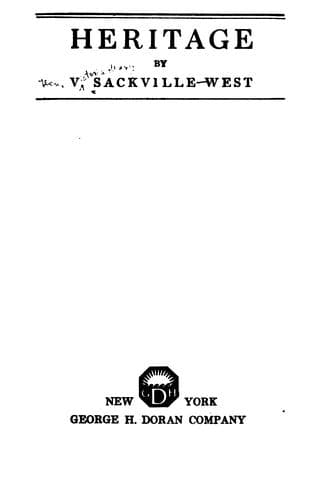
Eccentrics and eccentricities -- Fiction; Women -- Fiction
“‘This is my own brewing,’ she said to me.
“I thought that the cider must surely spill from my glass as I raised it
from the table, or that it must bubble and choke in my throat as I drank
with her eyes upon me. I felt trapped and prisoned, but in Westmacott’s
face there was nothing sinister, no trace of suspicion. He was not
playing a game with me. Perversely enough, I should have preferred an
outburst of fury on his part, to have felt his fist in my face, and to
roll with him, body grappling with body, on the floor. But this could
not be, and I must sit, drinking cider, between those two, a husband and
wife whom the flash of a revolver had so nearly separated not many weeks
beforehand, a revolver fired in anger and hatred, and in a desire for
freedom; I must sit there, near a woman between whom and myself
unforgettable words had been suddenly illuminatingly spoken. I laughed;
Westmacott had just made some remark to which my laugh came as an
inappropriate answer; he looked a little surprised, and I was hunting
about for some phrase to cover my lapse, when Ruth said,—
“‘Here are the boys.’
“They came in whistling, but fell silent as they saw me, and took their
caps off awkwardly. They were good-looking little boys—but I forget:
you’ve seen them. Westmacott glanced at them with obvious pride. Ruth
moved with her former steadiness to the cupboard to cut them each a
chunk of bread liberally spread with jam; she pushed their chairs close
up to the table, and ran her fingers through their rough mops of hair.
They began to eat solidly. Westmacott winked at me.
“‘There’s a mother for you,’ he said.
“I could make no reply to his hideous jocularity; if I had spoken, I
should have screamed.
“I felt that I should never escape, that the situation would last for
ever. I was, naturally enough, not very clear in my mind just then, but
already I seemed to see my recent scene with Ruth as a sunlit peak
bursting out of the dreariness and blindness of days, as brief as the
tick of a clock, but as vibrant as a trumpet-call, while the present
scene was long, interminable, flat as a level plain. Yes, that was my
impression: the peak and the plain. I longed to get away, that I might
dwell at my leisure upon that moment full of wonder. I bitterly resented
my bondage. I wanted to go away by myself to some solitary corner where
I might sit and brood for hours over the one moment in which, after
years of mere vegetation, I could tell myself that I had truly lived. I
felt that every minute by which my stay in that kitchen was prolonged,
was making of the place a thing of nightmare, instead of the enchanted
chamber it actually was, and this also I resented. Why could not I have
come, lived my brief spell, and gone with an untarnished treasure
imprisoned for ever within my heart? Why should perfection be marred by
the clumsiness of a farmer’s hospitality?
Public-domain text, read in full here on John Shaqi.
Reviews
Reviews
No reviews yet
Be the first to share your thoughts on this work.
Elsewhere in the archive
Join the Discussion
Join the discussion
Sign in to leave a comment or review.
Sign InorCreate an account