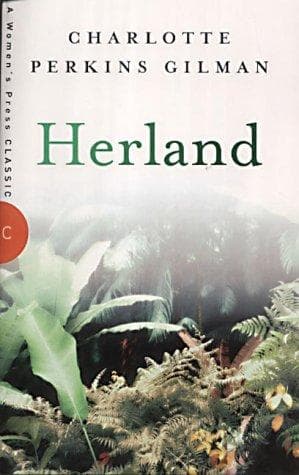
Black humor; Utopian fiction; Utopias -- Fiction; Women -- Fiction
Of all this I learned more and more--from their books, from talk,
especially from Ellador. She was at first, for a brief moment, envious
of her friend--a thought she put away from her at once and forever.
“It is better,” she said to me. “It is much better that it has not come
to me yet--to us, that is. For if I am to go with you to your country,
we may have ‘adventures by sea and land,’ as you say [and as in truth we
did], and it might not be at all safe for a baby. So we won’t try again,
dear, till it is safe--will we?”
This was a hard saying for a very loving husband.
“Unless,” she went on, “if one is coming, you will leave me behind. You
can come back, you know--and I shall have the child.”
Then that deep ancient chill of male jealousy of even his own progeny
touched my heart.
“I’d rather have you, Ellador, than all the children in the world. I’d
rather have you with me--on your own terms--than not to have you.”
This was a very stupid saying. Of course I would! For if she wasn’t
there I should want all of her and have none of her. But if she went
along as a sort of sublimated sister--only much closer and warmer than
that, really--why I should have all of her but that one thing. And I
was beginning to find that Ellador’s friendship, Ellador’s comradeship,
Ellador’s sisterly affection, Ellador’s perfectly sincere love--none
the less deep that she held it back on a definite line of reserve--were
enough to live on very happily.
I find it quite beyond me to describe what this woman was to me. We talk
fine things about women, but in our hearts we know that they are very
limited beings--most of them. We honor them for their functional powers,
even while we dishonor them by our use of it; we honor them for their
carefully enforced virtue, even while we show by our own conduct how
little we think of that virtue; we value them, sincerely, for the
perverted maternal activities which make our wives the most comfortable
of servants, bound to us for life with the wages wholly at our own
decision, their whole business, outside of the temporary duties of such
motherhood as they may achieve, to meet our needs in every way. Oh, we
value them, all right, “in their place,” which place is the home, where
they perform that mixture of duties so ably described by Mrs. Josephine
Dodge Daskam Bacon, in which the services of “a mistress” are carefully
specified. She is a very clear writer, Mrs. J. D. D. Bacon, and
understands her subject--from her own point of view. But--that
combination of industries, while convenient, and in a way economical,
does not arouse the kind of emotion commanded by the women of Herland.
These were women one had to love “up,” very high up, instead of down.
They were not pets. They were not servants. They were not timid,
inexperienced, weak.
Public-domain text, read in full here on John Shaqi.
Reviews
Reviews
No reviews yet
Be the first to share your thoughts on this work.
Elsewhere in the archive
Join the Discussion
Join the discussion
Sign in to leave a comment or review.
Sign InorCreate an account