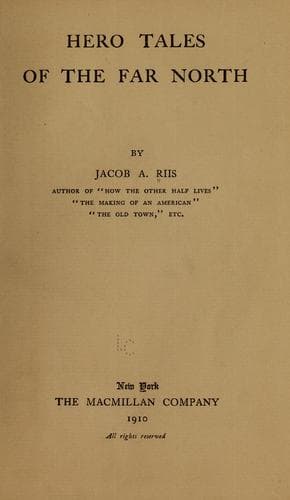
Hero Tales of the Far NorthRiis, Jacob A. (Jacob August)
History
Hero Tales of the Far North
Riis, Jacob A. (Jacob August)
Scandinavia -- History
Seven score years and one passed, and the morning of Holy
Thursday[14] saw a British fleet sailing slowly up the deep before
Copenhagen, the deck of every ship bristling with guns, their
crews at quarters, Lord Nelson’s signal to “close for action”
flying from the top of the flag-ship _Elephant_. Between the fleet
and the shore lay a line of dismantled hulks on which men with
steady eyes and stout hearts were guarding Denmark’s honor. Once
more it had been jeopardized by foolish counsel in high places.
Danish statesmen had trifled and temporized while England, facing
all Europe alone in the fight for her life, made ready to strike
a decisive blow against the Armed Neutrality that threatened
her supremacy on the sea. Once more the city had been caught
unprepared, defenceless, and once more its people rose as one man
to meet the danger. But it was too late. Outside, in the Sound, a
fleet as great as that led by Nelson waited, should he fail, to
finish his work. That was to destroy the Danish ships, if need
be to bombard the city and so detach Denmark from the coalition
of England’s foes. So she chose to consider such as were not her
declared friends.
Denmark had no fighting ships at home to pit against her. Her
sailors were away serving in the merchant marine. She had no
practised gunners, nothing but a huddle of dismantled vessels
in her navy-yard, most of them half-rotten hulks without masts.
Those that had standing rigging were even worse, for none of them
had sails and the falling spars in battle lumbered up the decks
and menaced the crew. But such as they were she made the most of
them. Eighteen hulks were hauled into the channel and moored head
and stern. Where they lay they could not be moved. Only the guns
on one side were therefore of use, while the enemy could turn and
manœuvre. They were manned by farm lads, mechanics, students,
enlisted in haste, not one of whom had ever smelt powder, and these
were matched against Nelson’s grim veterans. Even their commander,
J. Olfert Fischer, had not been under fire before that day, for
Denmark had had peace for eighty years. But his father had served
as a midshipman with Tordenskjold and the son did not flinch,
outnumbered though his force was, two to one, in men and guns.
Public-domain text, read in full here on John Shaqi.
Reviews
Reviews
No reviews yet
Be the first to share your thoughts on this work.
Elsewhere in the archive
Join the Discussion
Join the discussion
Sign in to leave a comment or review.
Sign InorCreate an account