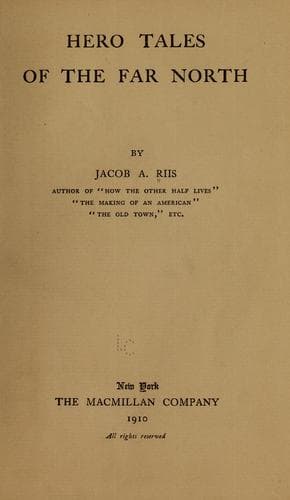
Hero Tales of the Far NorthRiis, Jacob A. (Jacob August)
History
Hero Tales of the Far North
Riis, Jacob A. (Jacob August)
Scandinavia -- History
All that is here set down seems simple enough. But it was
achieved with infinite toil and patience, by the most painstaking
experiments, many times repeated to make sure. In his method of
working Finsen was eminently conservative and thorough. Nothing
“happened” with him. There was ever behind his doings a definite
purpose for which he sought a way, and the higher the obstacles
piled up the more resolutely he set his teeth and kept right on.
“The thing is not in itself so difficult,” he said, when making
ready for his war upon the wolf, “but the road is long and the
experiments many before we find the right way.”
He took no new step before he had planted his foot firmly in the
one that went before; but once he knew where he stood, he did not
hesitate to question any scientific dogma that opposed him, always
in his own quiet way, backed by irrefutable facts. In a remarkable
degree he had the faculty of getting down through the husk to the
core of things, but he rejected nothing untried. The little thing
in hand, he ever insisted, if faithfully done might hold the key
to the whole problem; only let it be done _now_ to get the matter
settled.
Whatever his mind touched it made perfectly clear, if it was not
so already. As a teacher of anatomy he invented a dissecting knife
that was an improvement on those in use, and clamps for securing
the edges of a wound in an operation. As a rifle shot he made an
improved breech; as a physician, observing the progress of his
own disease, an effective blood powder for anaemia. At the Light
Institute, which friends built for him, and the government endowed,
he devised the powerful electric lamps to which he turned in
the treatment of lupus, for the sun does not shine every day in
Copenhagen; and when it did not, the lenses that gathered the blue
rays and concentrated them upon the swollen faces were idle. And
gradually he increased their power, checking the heat rays that
would slip through and threatened to scorch the patient’s skin, by
cunning devices of cooling streams trickling through the tubes and
the hollow lenses.
Nothing was patented; it was all given freely to the world. The
decision which he and his wife made together was made once for
all. When the great Nobel prize was given to him he turned it over
to the Light Institute, and was with difficulty persuaded to keep
half of it for himself only when friends raised an equal amount and
presented it to the Institute.
Public-domain text, read in full here on John Shaqi.
Reviews
Reviews
No reviews yet
Be the first to share your thoughts on this work.
Elsewhere in the archive
Join the Discussion
Join the discussion
Sign in to leave a comment or review.
Sign InorCreate an account