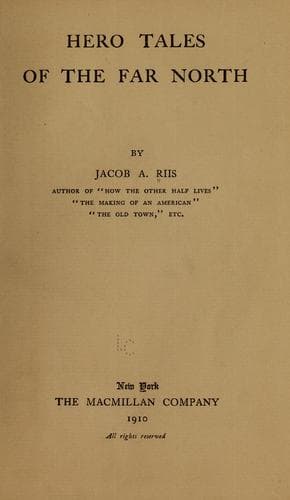
Hero Tales of the Far NorthRiis, Jacob A. (Jacob August)
History
Hero Tales of the Far North
Riis, Jacob A. (Jacob August)
Scandinavia -- History
[6] That all this in no way affected the personal relations of the
two men Saxo assures us in one of the little human touches with
which his chronicle abounds. When Eskild was going away to end his
days as a monk in the monastery of Clairvaux, he rested awhile with
Absalon at his castle Haffn, where he was received as a father. The
old man suffered greatly from cold feet, and Absalon made a box
with many little holes in, and put a hot brick in it. With this at
his feet, Eskild was able to sleep, and he was very grateful to
Absalon, both because of the comfort it gave him and “because that
he perceived that filial piety rather than skill in the healer’s
art” prompted the invention.
KING VALDEMAR, AND THE STORY OF THE DANNEBROG
To the court of King Ottocar of Bohemia there came in the year
1205 a brilliant embassy from far-off Denmark to ask the hand of
his daughter Dragomir for King Valdemar, the young ruler of that
country. Sir Strange[7] Ebbesoen and Bishop Peder Sunesön were the
spokesmen, and many knights, whose fame had travelled far in the
long years of fighting to bring the Baltic pagans under the cross,
rode with them. The old king received them with delight. Valdemar
was not only a good son-in-law for a king to have, being himself
a great and renowned ruler, but he was a splendid knight, tall
and handsome, of most courteous bearing, ambitious, manly, and of
ready wit. So their suit prospered well. The folk-song tells how
they fared; how, according to the custom of those days, Sir Strange
wedded the fair princess by proxy for his lord, and how King
Ottocar, when he bade her good-by, took this promise of her:
In piety, virtue, and fear of God,
Let all thy days be spent;
And ever thy subjects be thy thought,
Their hopes on thy care be bent.
The daughter kept her vow. Never was queen more beloved of her
people than Dagmar. That was the name they gave her in Denmark, for
the Bohemian Dragomir was strange to them. Dagmar meant daybreak
in their ancient tongue, and it really seemed as if a new and
beautiful day dawned upon the land in her coming. The dry pages of
history have little enough to tell of her beyond the simple fact of
her marriage and untimely death, though they are filled with her
famous husband’s deeds; but not all of his glorious campaigns that
earned for him the name of “The Victor” have sunk so deep into the
people’s memory, or have taken such hold of their hearts, as the
lovely queen who
Came without burden, she came with peace;
She came the good peasant to cheer.
Through all the centuries the people have sung her praise, and they
sing it yet. Of the many folk-songs that have come down from the
middle ages, those that tell of Queen Dagmar are the sweetest, as
they are the most mournful, for her happiness was as brief as her
life was beautiful.
Public-domain text, read in full here on John Shaqi.
Reviews
Reviews
No reviews yet
Be the first to share your thoughts on this work.
Elsewhere in the archive
Join the Discussion
Join the discussion
Sign in to leave a comment or review.
Sign InorCreate an account